13 October 2023

Just One Moment

Just One Moment


Just One Moment (RFW 051.38–053.08)

In the next four paragraphs of James Joyce’s Finnegans Wake―three in the original edition―our ongoing investigation into the HCE affair and the Battery at the Gate is interrupted by a visit to the movie theatre. This diversion is bookended by the phrases Just one moment and But resuming inquiries. Not surprisingly, both the main feature and the commercials that precede it share similar plots to HCE’s Original Sin or Crime in the Park.

First-Draft Version

The first draft of this section followed the previous section without a paragraph break, and was in its turn followed without a break by the next section, which describes HCE’s coffin:

Notice a fellow who calls on his skirt. He calls her honeylamb, swears they will be pals, by Sam, and share good times in a happy lovenest when May moon shines but that guy is not so tipsy (not on your life not in these trousers) for somewhere he has girl number two and he would like to canoodle her two for he is downright fond of number one and he is mashed on number two if he cd only canoodle the two and all three would be genuinely happy, the two numbers, namely, and their mutual chappy (for he is simply shamming dippy) if they were afloat in a dreamboat, his tippy canoe, his tippy up and down dippy hiptohippy canoe! So in the present case which bears all the earmarks of a plot. ―Hayman 73

There is nothing of the movie theatre here―the phrase earmarks of a plot suggests rather a radio drama―but by the time Joyce had prepared a new version of this passage for publication in Eugene Jolas & Elliot Paul’s literary journal transition in June 1927 it had acquired some traits that are unmistakeably cinematic:
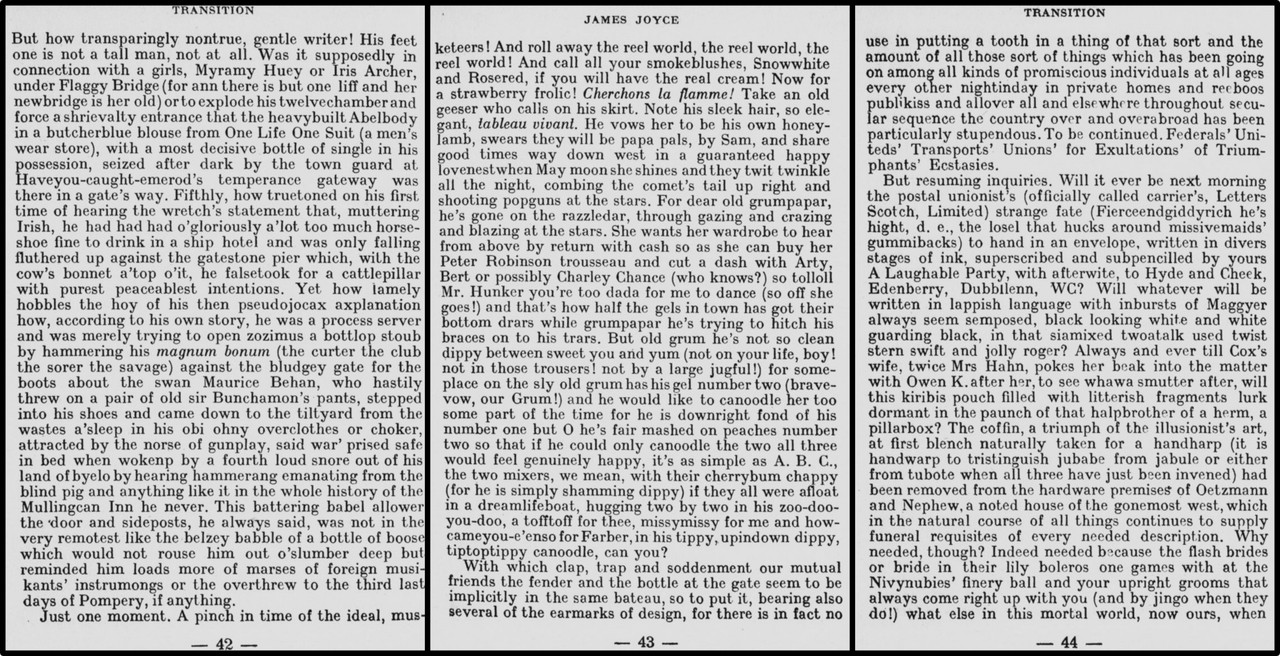
 

transition (Jolas & Paul 42–44)

Just one moment. A pinch in time of the ideal, musketeers! And roll away the reel world, the reel world, the reel world! And call all your smokeblushes, Snowwhite and Rosered, if you will have the real cream! Now for a strawberry frolic! Cherchons la flamme! Take an old geeser who calls on his skirt. Note his sleek hair, so elegant, tableau vivant. He vows her to be his own honeylamb, swears they will be papa pals, by Sam, and share good times way down west in a guaranteed happy lovenest when May moon she shines and they twit twinkle all the night, combing the comet’s tail up right and shooting popguns at the stars. For dear old grumpapar, he’s gone on the razzledar, through gazing and crazing and blazing at the stars. She wants her wardrobe to hear from above by return with cash so as she can buy her Peter Robinson trousseau and cut a dash with Arty, Bert or possibly Charley Chance (who knows?) so tolloll Mr. Hunker you’re too dada for me to dance (so off she goes!) and that’s how half the gels in town has got their bottom drars while grumpapar he’s trying to hitch his braces on to his trars. But old grum he’s not so clean dippy between sweet you and yum (not on your life, boy! not in those trousers! not by a large jugful!) for someplace on the sly old grum has his gel number two (bravevow, our Grum!) and he would like to canoodle her too some part of the time for he is downright fond of his number one but O he’s fair mashed on peaches number two so that if he could only canoodle the two all three would feel genuinely happy, it’s as simple as A. B. C., the two mixers, we mean, with their cherrybum chappy (for he is simply shamming dippy) if they all were afloat in a dreamlifeboat, hugging two by two in his zoo-doo-you-doo, a tofftoff for thee, missymissy for me and how-cameyou-e’enso for Farber, in his tippy, upindown dippy, tiptoptippy canoodle, can you?

With which clap, trap and soddenment our mutual friends the fender and the bottle at the gate seem to be implicitly in the same bateau, so to put it, bearing also several of the earmarks of design, for there is in fact no use in putting a tooth in a thing of that sort and the amount of all those sort of things which has been going on among all kinds of promiscious individuals at all ages every other nightinday in private homes and reeboos publikiss and allover all and elsewhere throughout secular sequence the country over and overabroad has been particularly stupendous. To be continued. Federals’ Uniteds’ Transports’ Unions’ for Exultations’ of Triumphants’ Ecstasies. ―Jolas & Paul 42–44


Peter Robinson Department Store (Oxford Street)

The story of the old geezer (chap = HCE) and his skirt (girlfriend = Issy) is now preceded by a few lines that will in time become two separate paragraphs. The first of these is best interpreted as taking place outside the cinema, while the second represents the commercials that are shown before the main feature. In the paragraph that follows the main feature we are told that the story is To be continued, a phrase that was frequently used in cinemas―and the print media―after episodes of a serial story.

By 1939, when the first edition of Finnegans Wake was published, this passage had been expanded into a sequence of three paragraphs. In The Restored Finnegans Wake of 2010 Rose & O’Hanlon inserted another paragraph break at Take an old geeser who calls on his skirt, resulting in four paragraphs. In this version the main feature is preceded by two short introductory paragraphs and followed by one short concluding paragraph. None of these was present in the first draft.

When they wrote A Skeleton Key to Finnegans Wake Joseph Campbell & Henry Morton Robinson were already aware that this passage was to be read as a visit to the movie theatre:

[At which point, suddenly, the American sugar-daddy digression:] Let us turn our eyes to the reel world. Come on, you boys and girls, settle back for a strawberry frolic! First appear the ads. (65 [RFW 052.11]) Then comes the following popular feature: Take an old geeser who calls on his skirt … ―Campbell & Robinson 74


Joseph Campbell & Henry Morton Robinson

James Atherton also discerned the presence of cinematic terms in this passage:

This trope of the literary creation of a world is best seen in Joyce’s treatment of films, a topic which has been surprisingly ignored in spite of such hints as ‛roll away the reel world, the reel world, the reel world’ (64.25 [RFW 052.01]).

The two preliminary paragraphs have been coloured by the HCE affair, as have the main feature and the epilogue.

Just One Moment

This short paragraph seems to take place as the roll of film is being readied. The real world is going to be replaced by the reel world. In the three musketeers, Athos, Porthos and Aramis, we can see Shem, Shaun and the Oedipal Figure. We also have Kevin & Jerry (Shaun & Shem), and the two Issy’s, Snowwhite and Rosered―cream is white, while strawberries are red. Kevin, as usual, is associated with Heaven (Keavens) and Jerry with Hell (Astrelea)―in Finnegans Wake Australia, or Down Under, often stands in for the Underworld.

The first draft of this paragraph was much shorter than the final version:

Just one moment! A little pinch in time of the ideal, gentlemen musketeers. (James Joyce Digital Archive)


Alexandre Dumas & The Three Musketeers

Several details of the final version anticipate the main feature, so perhaps this paragraph also represents a poster advertising the movie outside the cinema.

We had to pay to get into the Museyroom (the Paddy Patkinses, one shelenk), so it is only right that we be charged an entrance fee to enter the movie theatre:

  • French: filons, let us hand over. The usual meaning of filons is let’s get out of here! But Rose & O’Hanlon’s removal of the comma after filons supports my interpretation.

  • World War I Slang: filoosh, money. This is the tenth time Joyce has turned to Walter Hubert Downing’s Digger Dialects: A Collection of Slang Phrases Used by the Australian Soldiers on Active Service. Filoosh is identified by Digger as Arabic, which probably means that it comes from the Egyptian Arabic: فلوس [filūs], money (Downing 23). Below are several more borrowings from Downing:

    • chatbags (underclothing)
    • lump of lead (head)
    • sweatyfunnyadams [Sweet Fanny Adams] (nothing, vacuity)
    • Creampuffs (A shell-burst)
    • Every nice, missymackenzies [Very nice, very sweet, very clean, very good, Mister Mackenzie] (A street phrase of the Egyptian hawkers and shopkeepers, in extolling their wares to an Australian). Miss Mackenzie is the eponymous character in a novel by Anthony Trollope, who worked for the postal service in Ireland and introduced the pillar box to the British Postal Service in 1852. In the 1865 novel Miss Mackenzie has to choose between three suitors for her hand. These postal associations will be taken up on the next page.
    • Furphy (A rumour)
    • Compree (Understand). French: compris, understood.
    • chivoo (A celebration)
    • Finny (Finish). French: finis, finished (plural).
    • Ack, ack, ack (Full stop. Three A’s in a field telephone message signify the end of a sentence. Otherwise expressed as “three to a loaf,” “three of a kind,” etc.)
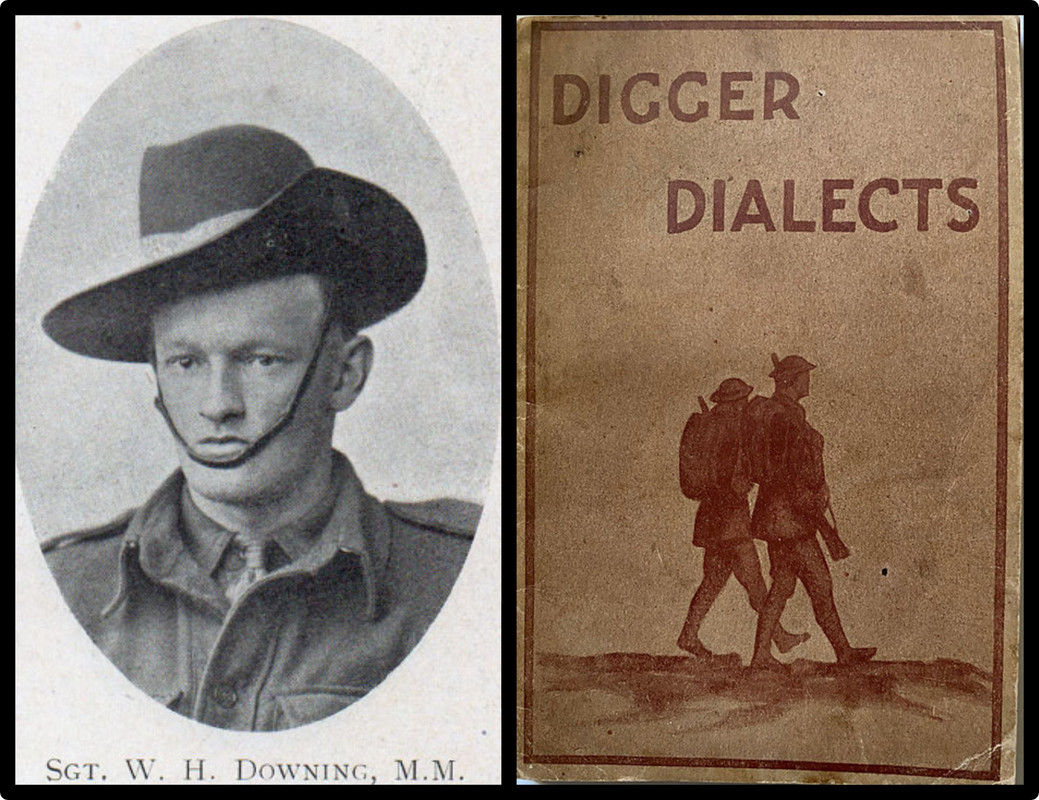
 

W H Downing & Digger Dialects

The presence of World War I slang used by Australian troops (Diggers) suggests that the three musketeers are soldiers from Down Under. This would explain why they are told to leave Australia for the astrologer Jerry:

This allegiance of Shem’s to the underworld of Australia is repeatedly established. He is not only an occult ‛alshemist’ but also a fraudulent astrologer. At 64.23 [RFW 051.39] the three musketeers are advised to ‛leave Australia to Jerry the Astrologer’―partly, perhaps, because there are rather more visible stars in the southern hemisphere. ―Hart 119

Finally, the projector’s bright lamp is illuminated:

Cherchons la flamme!

Commercials

Before the main feature we have some commercials. Weight loss and a cure for baldness are advertised―relevant, as HCE is certainly corpulent and losing his hair (RFW 041.21–22). There may also be an advertisement for a popular drink―a root beer made with bruised (ie crushed) ginger―and one for a muscle-building course. Joyce was inspired here by some issues of the popular magazine Picture Play, which was devoted to the movie industry (see MacArthur & Braslasu for details):

  • Noah Beery Noah Beery, Senior was a prolific star of early cinema. He is mentioned in the February 1931 issue of Picture Play. Joyce must have loved the accidental allusion to the Biblical Noah, who cultivated the vine and got drunk on his own beer (Genesis 9:20–27): a dreamlifeboat, hugging two by two in his zoo-doo-you-doo and in the same bateau.


Noah Beery, Sr

  • fat’s falling fast … why not yours? From an advertisement in Picture Play:

No need to tell you fat is going fast. Think back ten years ago. Most folks above 40 were over-fat. Now slender figures are everywhere the vogue … MARMOLA Prescription Tablets / The Right Way to Reduce ―Picture Play Magazine, January 1931, Page 111

  • Blossomtime’s Sigmund Romberg’s operetta Blossom Time is mentioned in the January 1931 issue of Picture Play.

There are also advertisements for Charles Atlas’s muscle-building course.

Take an Old Geeser

The main feature is patently yet another retelling of HCE’s Crime in the Park, with the familiar love triangles.

  • Finny In addition to the borrowing from Downing’s Digger Dialects we have here an allusion to FIN, the French word meaning The End that appeared at the end of many early movies.

After the Performance

  • Ack, ack, ack. Besides the borrowing from Downing’s Digger Dialects this represents the flapping sound made by the end of the roll of film as it spins in the projector.

  • clap, trap and soddenment Characteristics of the three Viconian Ages: thunder, marriage and burial. Also, clap represents the applause of the audience in the movie theatre.

  • To be continued In addition to the use of this phrase at the end of an installment of a popular cliffhanger in both the print media and on the silver screen, Joyce probably has the 1001 Nights in mind. In the frame story of this collection of folktales Scheherazade’s narration is repeatedly interrupted at dawn on a cliffhanger:

Hence the Persian proverb, “Báki-e-dastán fardá” (the rest of the tale tomorrow), said to askers of silly questions. ―Richard Francis Burton 145 fn 2


Richard Francis Burton

  • Federals’ Uniteds’ Transports’ Unions’ for Exultations’ of Triumphants’ Ecstasies An acrostic for Latin: futue te! fuck yourself!.

Joyce and Cinema

It is now a well known fact that James Joyce opened Ireland’s first cinema. This was one of the commercial ventures he undertook shortly after he left the country―before the publication of Ulysses made him famous and won for him the patronage of a wealthy and generous woman.

It was not until 1909 that Ireland’s first permanent cinema, the Volta, opened. The idea for the cinema originated in Trieste when James Joyce’s sister, Eva, commented that Dublin, a city larger than Trieste, had no cinema. James Joyce took up the idea with four local businessmen including exhibitors with cinema interests in Trieste and Bucharest. They agreed to put up the necessary capital while Joyce would organise the venture in return for a 10 per cent share of the profits. Joyce arrived in Dublin on 21 October 1909 and set about acquiring premises. This he did a week later when he located 45 Mary St, near Dublin’s main thoroughfare, Sackville St. He then proceeded to convert the premises into a cinema. Two of his Italian partners arrived a few weeks later and went with Joyce to both Belfast and Cork in search of further premises. Another partner and the cinema’s manager, Novak, arrived from Italy in early December accompanied by an Italian projectionist.


The Volta Shortly Before Its Demolition

For the opening of the Volta Cinema on 20 December 1909 Joyce chose a varied programme. Devilled Crab was a comedy while Bewitched Castle was ‛a magnificent fantastic picture’ according to the Dublin Evening Mail. Other films in the 35–40 minute programme were The First Paris Orphanage, La Pourponniere and a story of patricide, The Tragic Story of Beatrice Cenci (1908)’ which The Freeman’s Journal described as ‛very excellent’ but complained that it > was hardly as exhilarating a subject as one would desire on the eve of the festive season. But it was very much appreciated and applauded.

The Dublin Evening Mail had also found the films ‛very praiseworthy’ and the Volta ‛a fine hall’.

Despite the favourable notices for the new venture poor weather gave the cinema a slow start. Joyce did succeed in obtaining a permanent licence for the cinema from the Recorder but by this time his enthusiasm had begun to wane. He left Dublin for Trieste with his sister, Eileen, on 2 January leaving the management of the Volta in the hands of Novak. ―Rockett, Gibbons & Hill 5–6

Novak failed to make a go of it and he sold the Volta to an English firm, the Provincial Theatre Company, in July 1910, under whose management it became moderately profitable. Joyce received nothing from the sale. The theatre closed down in 1919, but two years later it reopened as the Lyceum Pictures Theatre. It closed its doors for good in 1948. The site was bought by the Irish retailer Penneys, who opened their first department store next door in 1969, almost exactly sixty years after the Volta first opened its doors. Ireland’s first cinema was subsequently demolished to make way for an extension to the department store. The site is now marked by a small plaque.


Penneys and the Volta Commemorative Plaque

And that’s as good a place as any to beach the bark of our tale.


References

Image Credits

Useful Resources

30 August 2023

Fifthly, How Truetoned


Truetone Radio : I Dreamt That I Dwelt in Marble Halls (RFW 051.05-37)

We continue our study of the episode known as The Battery at the Gate, which concludes Chapter 3 of James Joyce’s Finnegans Wake. This paragraph and the two that precede it originally comprised one unbroken passage. They were printed together when an early draft of this chapter was published in Eugene Jolas & Elliot Paul’s literary journal transition in June 1927. When the first edition of Finnegans Wake came out in 1939, this paragraph was set off from the other two. The latter were finally divorced by Danis Rose & John O’Hanlon in 2010 in The Restored Finnegans Wake.

As we have seen, Joyce based The Battery at the Gate on a story he came across in the Freeman’s Journal about an attempted break-in on Sheriff Street, Dublin. The story appeared on 21 November 1923, just as Joyce was drafting this section:

Richard Whitely, Patrick Farrell, and William Hannon were found guilty at the Commission, charged with having at an early hour of the morning of Sunday, October 7, attempted to break into Pickford’s Store, 6 Upper Sheriff street, with intent to steal goods. It was stated by P.C. Sutton that he and another constable saw the three prisoners at the gate of the store. Hannon was pushing the gate with his shoulder and the others were standing by. When they saw witness they moved to a dark doorway. Whitely was carrying a fender. When witness asked where he got the fender one of the men said “that is for you to find out.” Whitely speaking from the dock, said they were only trying to open a bottle of stout by hammering it against the gate.

Drawing a Cork

The Lord Chief Justice (to the police witness): ―I suppose you know how to draw the cork out of a bottle of stout (a laugh). “Yes,” replied the witness. The Lord Chief Justice: Was the sound you heard like trying to get the cork out of a bottle? Witness: Nothing like it (laughter). ―Freeman’s Journal 21 November 1923


Upper Sheriff Street

First Draft

The first-draft version of this paragraph consisted of two sentences and was about eight lines long:

How true at first hearing his statement that he had had a lot too much to drink and was falling against the gate yet how lame proceeds his then excuse that he was merely trying to open the bottle of stout by hammering it against the gate for the boots, Maurice Behan, who threw on a pair of pants and came down in his socks without a coat attracted by noise of gunplay was in bed wakened up by loud hammering at the gate. This was not in the least like a bottle of stout which would not rouse him out of sleep but much more like the overture to the last day if anything. ―Hayward 73

Joyce proceeded to expand this brief passage after the usual fashion. By the time the third issue of transition came out it had grown to twenty-six lines.

Another ten or eleven lines had been added to this by 1939, when Finnegans Wake was finally published. The accused man’s drunken binge, which originally consisted of just a single ship hotel, now takes in more than half-a-dozen watering holes. Note also how the single word overture―a piece of music that opens an opera―has now blossomed into a whole suite of musical allusions, running to seven or eight lines.


transition 3 (Jolas & Paul 42)

Dublin Pubs

In the first draft of this passage the Cad (or whoever is trying to break into HCE’s tavern in the middle of the night) is drunk, having had a lot too much to drink. But we are not told where he became intoxicated. In the revised version published by transition we are told that he had too much to drink in a ship hotel. Presumably, this refers to The Ship Hotel and Tavern on Lower Abbey Street, which is mentioned a few times in Ulysses.

By the time Joyce was finished with this passage the Cad’s drinking bout had become a day-long binge, taking in seven establishments:

… the House of Blazes, the Parrot in Hell, the Orange Tree, the Glibt, the Sun, the Holy Lamb and, lapse not leashed, in Ramitdown’s ship hotel

Joyce has once again being consulting Ada Peter’s Dublin Fragments: Social and Historic, which was published in 1925:

Many of the old names of the inns and taverns of Dublin were quaint and curious … the “House of Blazes” on Aston’s Quay still retained its sinister appellation far on into the nineteenth century … “The Sun” was not far off in “St. Thomas, his Streete”. “The Orange Tree” was likewise in Castle Street, and “The Glibb” near to “The Sun”. “The Parrot” was in “Hell” … “The Holy Lamb” was in the old Corn Market. ―Peter 93–96

  • Hell This was the name of a lane that ran from St Michael’s Hill (at the top of Winetavern Street, where the Christ Church Arch crosses the road) to the old Four Courts, which stood just to the south of Christ Church Cathedral. It appears on John Rocque’s 1756 Map of Dublin. The name was commonly applied to the whole area between Fishamble Street and Christ Church Lane, a place of ill repute in the 18th century.


Hell

  • Glibt Ada Peter calls this public house The Glibb. Is Joyce’s Glibt a misprint? Did Joyce misread Peter’s Glibb? The Glibb (Glib, or Glibb-Water) was an artificial rivulet created to supply water to St Thomas Street in 1670 (Mink 329).

Maurice Behan

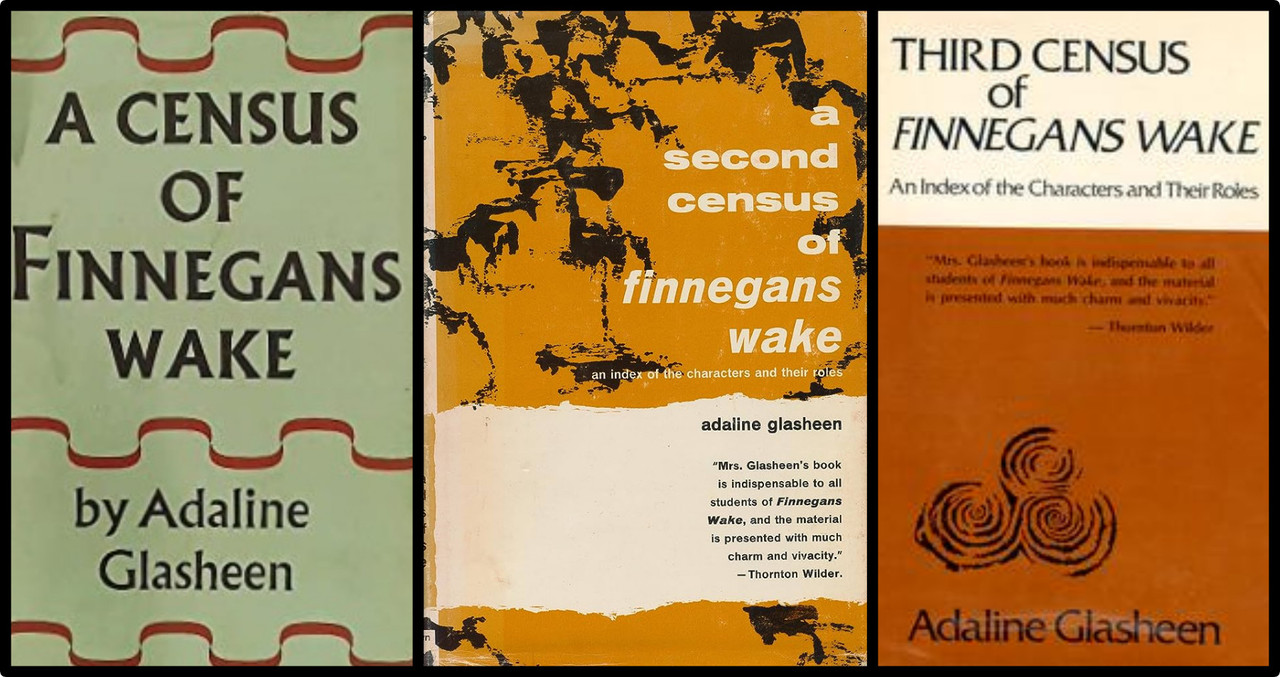
In the first edition of A Census of Finnegans Wake Adaline Glasheen briefly introduces the book’s various characters:

Archetypes of the second rank include … a man servant, so impenetrably mysterious that I cannot give his name … He is called Old Joe several times; he is called Mahan; he is called Behan. Probably his name is Maurice Behan, because he is known as Mauritius in the passage 572–573 [RFW 445.31–446.31]. He also appears to be Constable Sacksoun (and variations). Certain commentators have believed that his name is Tom because of the repetition of Tom-Tim that beats through the book, but I see no evidence of this. If he is Constable Sacksoun, it is reasonable to assume―as the authors of A Skeleton Key do assume―that he is also the other policeman, Lally, who is particularly associated with the Four. ―Glasheen 1956:ix … 83

Unlike Glasheen, we now know that Joyce borrowed the name Maurice Behan from the article in the Freeman’s Journal that inspired The Battery at the Gate:

Maurice Behan, caretaker of the stores, said that he was in bed and heard heavy hammering at the gate. ―Freeman’s Journal, 21 November 1923


Three Censuses of Finnegans Wake

Nine years later, when A Second Census of Finnegans Wake was published, Glasheen had acquired a better understanding of HCE’s Man Servant and his rôle in the book, but her ideas are still disparate and all over the shop:

He is “most mousterious”, meaning primitive (Mousterian), a servant-monster like Caliban … and mysterious. He goes by certain names―Old Joe, Maurice (Moor), Behan-Beham (see Ham)―which are names of the dark races in their servitude. On the other hand, he is called Constable Saxon (and variations) and described as “butterblond”. I assume therefore that he represents any subject race―black Ham, servant to white brothers―white Saxon Harold, servant to Norman William. The Irishman, Stephen Dedalus, describes himself as servant to England, the Saxon … In the “Mutt and Jute” episode the Man Servant is Mutt.

Another name of the Man Servant is Mahan or Mahon … A queer sort of man he seems to the conqueror: subject races are always queer, they smell funny, they are half animal. A queer sort of “mahan” means, at the same time, a queer sort of animal, for “mahan” and “mahon” … are anglicizations of the Irish Mathghamhain or “bear”. (Art is also from an Irish [recte Welsh] word for “bear”, but I don’t think Joyce uses it so.) Mahan-as-bear fits, of course, neatly with the fact that the Man Servant is also Sackerson, the bear at the Paris Gardens on the Bankside … (The bear theme in FW should be looked into.) Since I think FW is about Shakespeare, I am delighted to find the Man Servant associated with both Caliban, the red Indian, and the baited bears of the Bankside. The form of Behan at 333.15 [RFW 257.06], “behomeans”, is nearly an anagram of “Bohemians” and reminds us of the Bohemian bear in The Winter’s Tale. ―Glasheen 1965:166


Sackerson the Bear

Glasheen speculates further on this bear theme, before concluding:

There is plainly much to be worked out about the Man Servant, but I really do not think this note is too heavily weighted with bear. Hibernating, waking, the bear makes a very fair symbol of resurrection, personal or national; Bruin is always the gull in Reynard stories; the bear can be made to dance and ride a bicycle; he walks upright and on all fours, exemplifying inferior races which seem half-bestial to their masters.

The Man Servant represents not only the subject races of modern history, but the more primitive races of pre-history. He is “mousterious” and in the Mousterian period, Neanderthal man was giving up the ghost. More than that, the Man Servant as bear represents, I think, that most subject of all kingdoms, the animal. The bear was here on earth before man, just as the Utah Indian was on the American continent and Caliban in Bermuda before Prospero or Trinculo-Stephano came to outsmart him. The Man Servant is not only subject, he is dispossessed, and as dispossessed ties onto one of the great themes of FW, a theme which includes the Irish ass, St Patrick (when he was a slave with four masters), Esau, Ham, Hamlet, Havelok, and even Adam, dispossessed of Eden and become a toiler. ―Glasheen 1965:166–167

Even as late as 1977, when the definitive Third Census of Finnegans Wake was published, Glasheen was still struggling to pin down this character:

… my understanding of him is too wavery and intermittent for summary. He is a nasty, old, drunk, abased handyman at the inn, “curate” at the bar. By times he represents the dark usurped races―Utah Indian, Moor as Maurice, brown as bear or Mahan, black as Jo, Behan-Beham (see also Ham, Black Man), or Mutt as racial mongrel.

At other times, (by what mechanism?) he is “butterblond” Constable Sacksoun, also old, drunk, abased, nasty, and a policeman and informer, hateful and hating, who does his master’s dirty work, as the black does his physical dirty work.

The Man Servant “most mousterian” (i.e., Neanderthal) is also the usurped, our dead ancestors, or he is a living primitive―Stone Age man of Africa, Nazi, or American redneck. He is also our ancestors, the animals, especially extinct animals like dragons, snakes-in-Ireland, baited bears, mastodon and Behemoth. Perhaps the Man Servant is the old age of Milton’s Satan. ―Glasheen 1977:184–185


Adaline Glasheen

Stephen Hero

It may not or may be relevant but Finnegans Wake is not the first of James Joyce’s works to feature a character called Maurice. In Joyce’s first novel, the unfinished and autobiographical Stephen Hero, Stephen’s brother and sounding board is called Maurice. This character was based on Joyce’s closest brother Stanislaus, who did indeed serve as a sympathetic confidant during James’s sentimental education. Joyce eventually abandoned Stephen Hero and recast it as A Portrait of the Artist as a Young Man. In this form the character of Maurice has all but disappeared, making just one brief appearance in Chapter II.

The origin of Stephen Hero is recounted by Richard Ellmann in his biography of Joyce. It all began with a short, highly-condensed autobiographical essay Joyce wrote in January 1904:

At the beginning of 1904 he learned that Eglinton and another writer he knew, Fred Ryan, were preparing to edit a new intellectual journal named Dana after the Irish earth-goddess. On January 7 he wrote off in one day, and with scarcely any hesitation, an autobiographical story that mixed admiration for himself with irony. At the suggestion of Stanislaus, he called it ‛A Portrait of the Artist,’ and sent it to the editors. This was the extraordinary beginning of Joyce’s mature work. It was to be remolded into Stephen Hero, a very long work, and then shortened to a middle length to form A Portrait of the Artist as a Young Man. But this process took ten years …

The essay narrative was duly submitted to Eglinton and Ryan, and by them duly rejected. Eglinton told Joyce, ‛I can’t print what I can’t understand,’ and objected to the hero’s sexual exploits, whether with the dream lady of his litany or with the real prostitutes. Joyce took this rejection as a challenge to make the fictional history of his own life the call to arms of a new age. ―Ellmann 144 … 147

Stanislaus Joyce takes up the story in his diary:

2nd February: 1904: Tuesday. Jim’s birthday. He is twenty-two [to]day. He was up late and did not stir out all day, having a bad cold. He has decided to turn his paper into a novel, and having come to that decision is just as glad, he says, that it was rejected. The paper … was rejected by the editors, Fred Ryan and W. Magee (‛John Eglinton’) because of the sexual experiences narrated in it. Jim thinks that they rejected it because it is all about himself, though they professed great admiration for the style of the paper. They always admire his style … Jim is beginning his novel, as he usually begins things, half in anger, to show that in writing about himself he has a subject of more interest than their aimless discussion. I suggested the title of the paper ‛A Portrait of the Artist’, and this evening, sitting in the kitchen, Jim told me his idea for the novel. It is to be almost autobiographical, and naturally as it comes from Jim, satirical. He is putting a large number of his acquaintances into it, and those Jesuits whom he has known. I don’t think they will like themselves in it. He has not decided on a title, and again I made most of the suggestions. Finally a title of mine was accepted: ‛Stephen Hero,’ from Jim’s own name in the book ‛Stephen Dedalus.’ The title, like the book, is satirical. Between us we rechristened the characters, calling them by names which seemed to suit their tempers or which suggested the part of the country from which they come. Afterwards I parodied many of the names: Jim, ‛Stuck-up Stephen’; Pappie, ‛Sighing Simon’; myself, ‛Morose Maurice’; the sister, ‛Imbecile Isobel’; Aunt Josephine (Aunt Bridget), ‛Blundering Biddy’; Uncle Willie, ‛Jealous Jim.’ ―Healey 11–12 : Ellmann 152–153

Joyce worked on Stephen Hero over the next few years. By March 1906 he had written 914 pages and 25 chapters. He is thought to have abandoned the work in late June or early July 1906, when he was living in Trieste (Norburn 26). Only a fragment of the manuscript survives. The opening 518 pages have been lost. The earliest extant fragment begins in the middle of Chapter XV and the last pages are from Chapter XXVI. In September 1907, after completing Dubliners, Joyce began to recast it (Norburn 37).


Stanislaus Joyce

In Finnegans Wake it is the character of Shaun who is most commonly associated with Stanislaus. I do not think there is anything of Stanislaus in HCE’s elderly Man Servant. It is probably a coincidence that the same name Maurice was used for these two characters.

Music

In the first draft of this passage Maurice Behan gave evidence that the noise that roused him from his bed did not sound like someone trying to open a bottle of stout:

This was not in the least like a bottle of stout which would not rouse him out of sleep but much more like the overture to the last day if anything. ―Hayward 73

As we have seen, Joyce was inspired by the musical meaning of the word overture to expand this for transition:

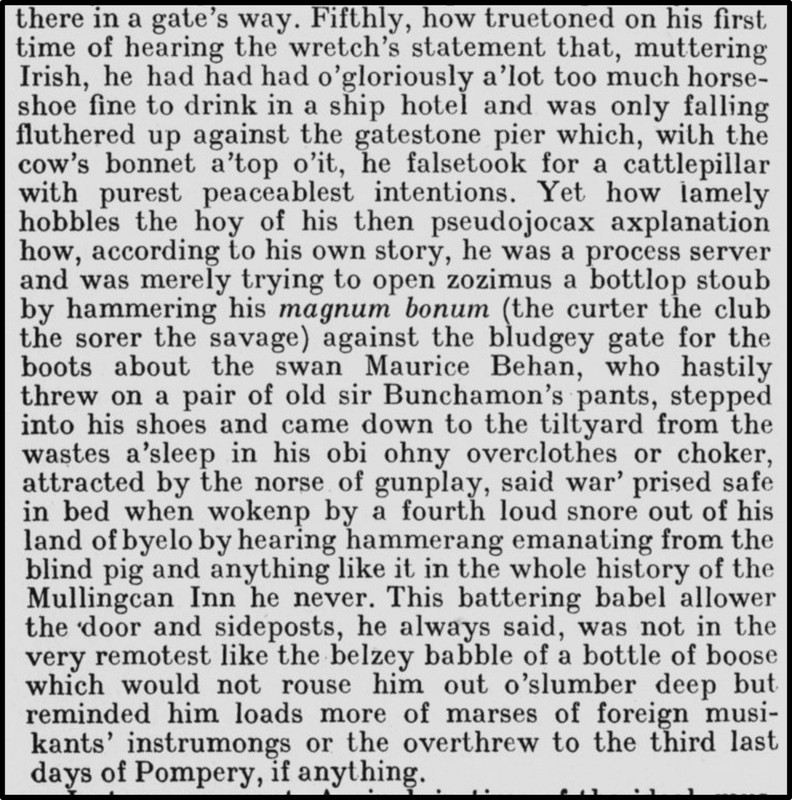
This battering babel allower the door and sideposts, he always said, was not in the very remotest like the belzey babble of a bottle of boose which would not rouse him out o’slumber deep but reminded him loads more of marses of foreign musikants’ instrumongs or the overthrew to the third last days of Pompery, if anything. ―Jolas & Paul 42

By 1939, however, he has added several more lines of musical allusions, many of them with warlike connotations:

This battering babel allover the door and sideposts, he always said, was not in the very loutest like the belzeybabble of a bottle of boose which would not rouse him out o’ slumber deep but reminded him loads more of the martiallawsey marses of foreign musikants’ instrumongs playing Delandy is Cartager on the ragnar rock to Dulyn or the overthrewer to the third last days of pompery, if anything. And that after this most mooningless knockturn the young reine came down desperate and the old liffopotamus herself started ploring all over the plain, as mud as she cud be, ruinating all the bouchers’ schurts and the backers’ wischandtugs so that, be the chandeleure of the Rejaneyjailey, they were all nigh wasching the walters off, the weltering walters off. Whyte?


Thomas Osborne Davis (The West’s Asleep)

  • o’ slumber deep When Connaught lies in slumber deep, a line from the patriotic ballad by Thomas Osborne Davis The West’s Asleep (often known incorrectly as The West’s Awake, but alluded to nine lines above as the wastes u’sleep).

  • martiallawsey La Marseillaise, the French national anthem―a martial song.

  • marses marches, with Mars, the god of war.

  • German: Musikant, musician.

  • instrumongs instruments. English Dialect: mong, a muddle or confusion : a mingling or mixture.

  • overthrewer_overture_, overthrow.

  • Delandy is Cartager When Hosty’s ballad was given its première in the previous chapter, a Mr Delaney (Mr Delacey?) played the horn. I am not aware of any pieces of music about the fall of Carthage (Carthago delenda est). Henry Purcell’s opera Dido and Aeneas and Hector Berlioz’s grand opera Les Troyens are probably the best known works associated with the ancient city.

  • the ragnar rock to Dulyn The Rocky Road to Dublin, a 19th-century Irish song. The lyrics were written by the Irish poet D K Gavan. Mr Deasy recites a few lines in the Nestor episode of Ulysses.

  • Old Norse: Ragnarǫk, Fate of the Gods. In Norse mythology Ragnarök is the cataclysmic end of the world. It will culminate in a great battle in which many of the gods will die. After this the world will begin anew. The word is often translated inaccurately as Twilight of the Gods―in German, Götterdämmerung―which Richard Wagner chose as the name of the concluding part of his operatic cycle Der Ring des Nibelungen (The Ring of the Nibelung).

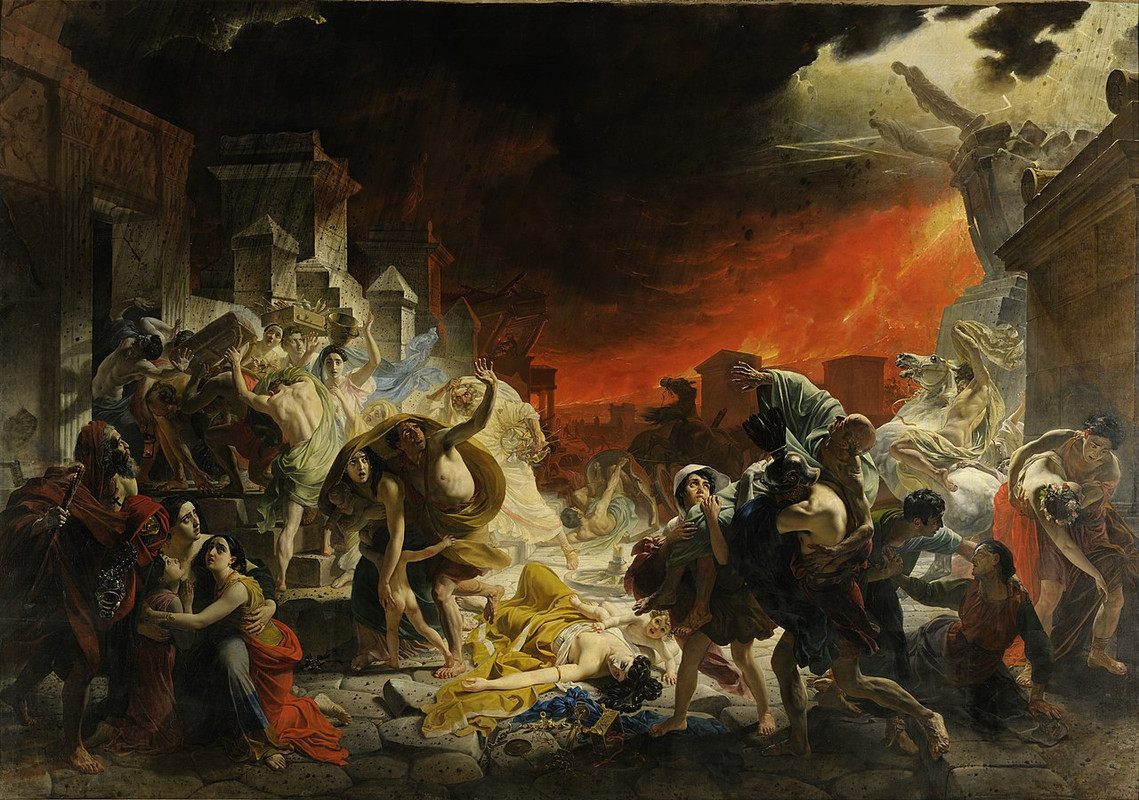
  • the third last days of pompery Edward Bulwer-Lytton’s novel The Last Days of Pompeii (1834) is the obvious reference, but there may also be an allusion to Giovanni Pacini’s opera L’ultimo giorno di Pompei [The Last Day of Pompeii] (1825). It is thought that the opera inspired Karl Brullov’s painting of the same name (1830–33), which in turn inspired Bulwer-Lytton’s novel. John Gordon also sees an allusion to Pompey the Great, who was thrice elected Consul and was given three triumphs, before being overthrown by Caesar.


The Last Day of Pompeii

  • mooningless knockturn nocturne, a musical form invented by the Dublin-born composer John Field. mooningless could also include an allusion to Beethoven’s Moonlight Sonata. The first edition had nooningless.

  • Rejaneyjailey Latin: Regina Coeli, Queen of Heaven, a musical antiphon addressed to the Virgin Mary. Over the centuries this short Medieval text has been set to music by numerous composers, including Victoria, Palestrina, Lully, Mozart and Brahms. There is also a jail in Rome known as Regina Coeli, which had once been a convent. According to John Gordon, be the chandeleure of Rejaneyjailey [by the chandelier of the Queen of Heaven] means by the light of the moon (Gordon 64.19).

There are other musical allusions scattered elsewhere in this paragraph:

  • Fifthly … fourth … third Musical intervals?

  • truetoned In the 1930s Truetone was a brand name used by the Western Auto Supply Company of Kansas City for radios, phonographs, televisions and guitars.

  • the engine of the laws declosed unto Murray The Angel of the Lord declared unto Mary, the opening words of the Angelus, which is announced by the ringing of bells.

  • fillthefluthered Percy French’s song Phil the Fluter’s Ball. In his short story Grace (Dubliners) Joyce coined the word peloothered, meaning very drunk, but fluthered is genunie Irish slang.

  • he dreamed that he’d wealthes in mormon halls I Dreamt That I Dwelt in Marble Halls, an aria from Michael William Balfe’s opera The Bohemian Girl. In 1922 a silent movie inspired by the opera was released.

Viconian Structure

The last five lines of this paragraph anticipate Anna Livia Plurabelle, the concluding chapter in Book I. Note that the final version of this paragraph comprises precisely four sentences (followed by the single word Whyte?) Are we to interpret these along Viconian lines? It is a bit of a stretch, perhaps, but the first sentence does hark back to the ancient times of Hengist and Horsa : the second sentence, with Sir Bunchamon, the tiltyard, Open Sesame and The Bohemian Girl, evokes the medieval world of Romance : the third sentence alludes to the last day : and the fourth sentence, as we have just said, unmistakably foreshadows the ricorso storico that brings Book I to an end.


The Washers at the Ford

Transmission Errors

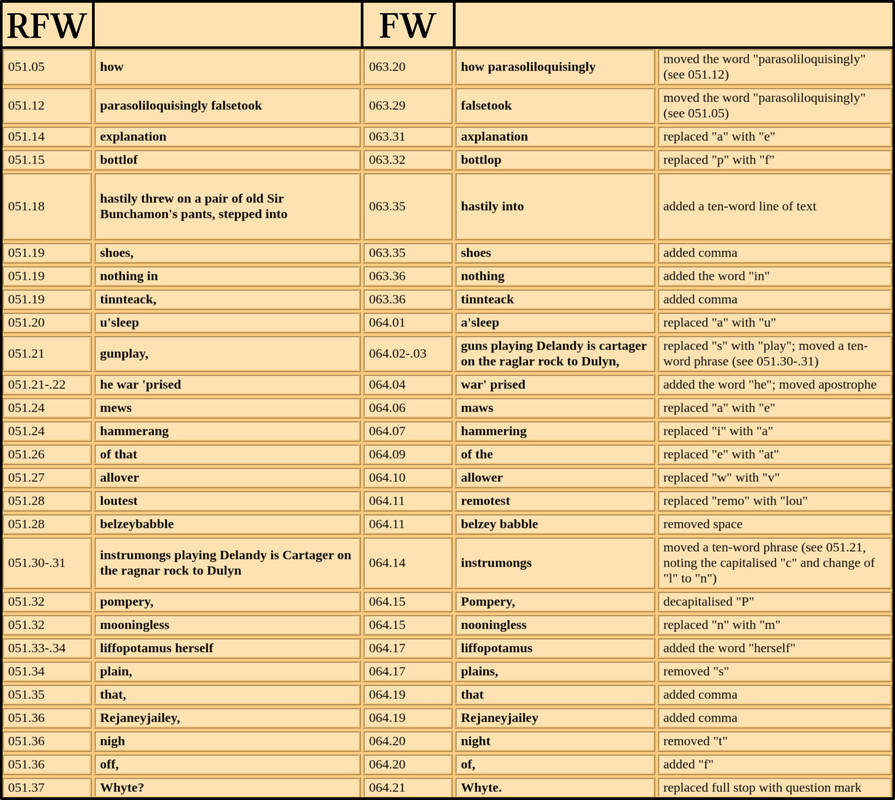
When this passage was being prepared for final printing, someone inadvertently omitted a ten-word line:

threw on a pair of old sir Bunchamon’s pants, stepped … ―RFW 051.18

The first edition of 1939 reads:

… Maurice Behan, who hastily into his shoes … ―FW 063.35

Joseph Campbell & Henry Morton Robinson spotted this error and supplied the missing line from transition (Campbell & Robinson 73, 366). The fact that the missing words constitute a complete line in transition suggests that a copy of transition was consulted when this passage was being prepared for printing. Whoever was consulting transition skipped over this line. Who was the guilty party? We can acquit the typesetter, because the final version of this passage is different from the version that appeared in transition:

boots about the swan Maurice Behan, who hastily threw on a pair of old sir Bunchamon’s pants, stepped into his shoes and came down to the tiltyard from the

transition June 1927

for the boots about the swan, Maurice Behan, who hastily into his shoes with nothing his hald barra tinnteack and came down with homp, shtemp and jumphet to the tiltyard from the

Finnegans Wake 1939

Note that the first edition also omitted the word in before his hald … Joyce must have been the guilty party.

Another ten-word phrase was misplaced. The words:

playing Delandy is Cartager on the ragnar rock to Dulyn … ―RFW 051.30–31

were moved to an earlier line, and slightly altered to:

guns playing Delandy is cartager on the raglar rock to Dulyn, ―FW 064.03

There are about two dozen other minor differences between the corrected edition of Finnegans Wake (Faber and Faber 1950 : Viking Press 1958) and The Restored Finnegans Wake (2010):


Finnegans Wake Errata

And that’s as good a place as any to beach the bark of our tale.


References

  • Joseph Campbell, Henry Morton Robinson, A Skeleton Key to Finnegans Wake, Harcourt, Brace and Company, New York (1944)
  • Thomas Osborne Davis, The West’s Asleep, The Spirit of the Nation, Second Edition, Revised, Pages 19–20, James Duffy, Dublin (1844)
  • Adaline Glasheen, A Census of Finnegans Wake, Northwestern University Press, Evanston, Illinois (1956)
  • Adaline Glasheen, A Second Census of Finnegans Wake, Northwestern University Press, Evanston, Illinois (1963)
  • Adaline Glasheen, Third Census of Finnegans Wake, University of California Press, Berkeley, California (1977)
  • David Hayman, A First-Draft Version of Finnegans Wake, University of Texas Press, Austin, Texas (1963)
  • George H Healey (editor), The Complete Dublin Diary of Stanislaus Joyce, Cornell University Press, Ithaca, New York (1971)
  • Eugene Jolas & Elliot Paul (editors), transition, Number 3, Shakespeare & Co, Paris (1927)
  • James Joyce, Finnegans Wake, The Viking Press, New York (1958, 1966)
  • James Joyce, James Joyce: The Complete Works, Pynch (editor), Online (2013)
  • Louis O Mink, A Finnegans Wake Gazetteer, Indiana University Press, Bloomington, Indiana (1978)
  • Ada Peter, Dublin Fragments: Social and Historic, Hodges Figgis & Co, Dublin (1925)
  • Danis Rose, John O’Hanlon, The Restored Finnegans Wake, Penguin Classics, London (2012)

Image Credits

Useful Resources

31 July 2023

But How Transparingly Nontrue


Flaggy Bridge, New Bridge & Guinness Bottles (RFW 050.36–051:04)

We continue our journalistic investigation into the HCE Affair. The last ten pages of Chapter 3 comprise an episode known as The Battery at the Gate. Following his condemnation in the court of public opinion―as expressed in the Plebiscite―HCE takes refuge within his tavern. This short paragraph was originally part of the previous paragraph, and, indeed, these two paragraphs were printed as one continuous paragraph when the first edition of Finnegans Wake was published in 1939. They were separated by Danis Rose & John O’Hanlon for The Restored Finnegans Wake in 2010. According to the James Joyce Digital Archive, Joyce actually split them during draft level 8, around 1930-1933.

As we learned in the previous article, Joyce spun this section out of some stories he came across in the popular press. He was particularly taken with an account in the Freeman’s Journal of an attempted break-in that occurred on Sheriff Street, Dublin, in October 1923, which was about a month before he first drafted this section:

Richard Whitely, Patrick Farrell, and William Hannon were found guilty at the Commission, charged with having at an early hour of the morning of Sunday, October 7, attempted to break into Pickford’s Store, 6 Upper Sheriff street, with intent to steal goods. It was stated by P.C. Sutton that he and another constable saw the three prisoners at the gate of the store. Hannon was pushing the gate with his shoulder and the others were standing by. When they saw witness they moved to a dark doorway. Whitely was carrying a fender. When witness asked where he got the fender one of the men said “that is for you to find out.” Whitely speaking from the dock, said they were only trying to open a bottle of stout by hammering it against the gate … (Freeman’s Journal 21 November 1923)


Upper Sheriff Street

First Draft

The first draft of this paragraph was only about three lines long, but it did introduce the gate and the bottle of stout:

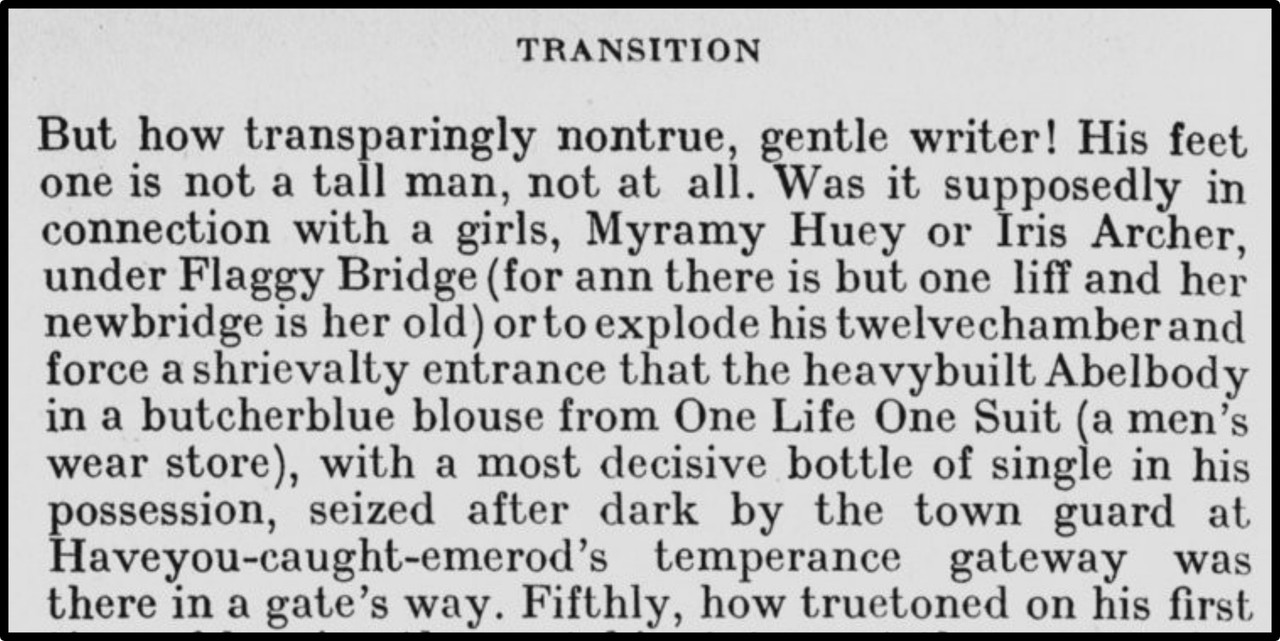
But how untrue. Six feet is not tall. Was it to explode & to force entrance that the man with a bottle of stout in his possession seized by the town guard in his very gateway was in the gateway. (Hayman 72–73)

The first draft of the previous paragraph, you may recall, comprised only a single line:

When returning late to the old spot a revolver was put to his face. (Hayman 72)

Joyce later emended this to:

A tall man returning late to the old spot had a revolver put to his face. (Hayman 72)

This emendation must have been made almost immediately. Otherwise the phrase Six feet is not tall in the first draft of the present paragraph would have made no sense.

Joyce worked on this passage over the next few years, and in June 1927, when a revised draft of this chapter was published in the third issue of Eugene Jolas & Elliot Paul’s literary journal transition, this paragraph read as follows:


transition 3 (Jolas & Paul 42)

The following paragraph―Fifthly …―was still part of this long paragraph. By 1939 it had gained its independence. Otherwise, this passage is very close to the final version. Joyce made only a few minor emendations between 1927 and 1939.

Commentary

  • transparingly nontrue transparently untrue : sparingly

  • gentle writer gentle reader is the traditional way a novelist addresses his readers, but writer is appropriate here, given the journalistic nature of this chapter. In the original edition this read gentlewriter : transition had gentle writer.

  • No such parson. No such fender. No such lumber. No such race. Grammatical terms: person, gender, number, case. New Bridge, which appears three lines below, is partly in the townland of Parsonstown, County Kildare. The mysterious fender was introduced in the last paragraph.

  • a girl, Myramy Huey or Colores Archer Issy’s twin personalities. In transition and the first edition this read a girls. Rose & O’Hanlon restored the original form in 2010. The singular emphasizes that there is really only one girl.

The colourful attributes remind us that Issy’s 28 girlfriends are closely associated in Finnegans Wake with that Noachic symbol of regeneration the rainbow:

  • Latin: mira me, admire me : Myra, a girl’s name.

  • Huey hue. Hugh is a boy’s name.

  • Colores colour : Dolores, a girl’s name.

  • Archer The arch of the rainbow : French: arc de ciel, rainbow. Arthur is a boy’s name.

Issy is the 29th rainbow girl, the leap-year girl―29 February is her birthday. Is this why Joyce introduces Leixlip (the site of New Bridge) below? Leixlip means salmon leap.


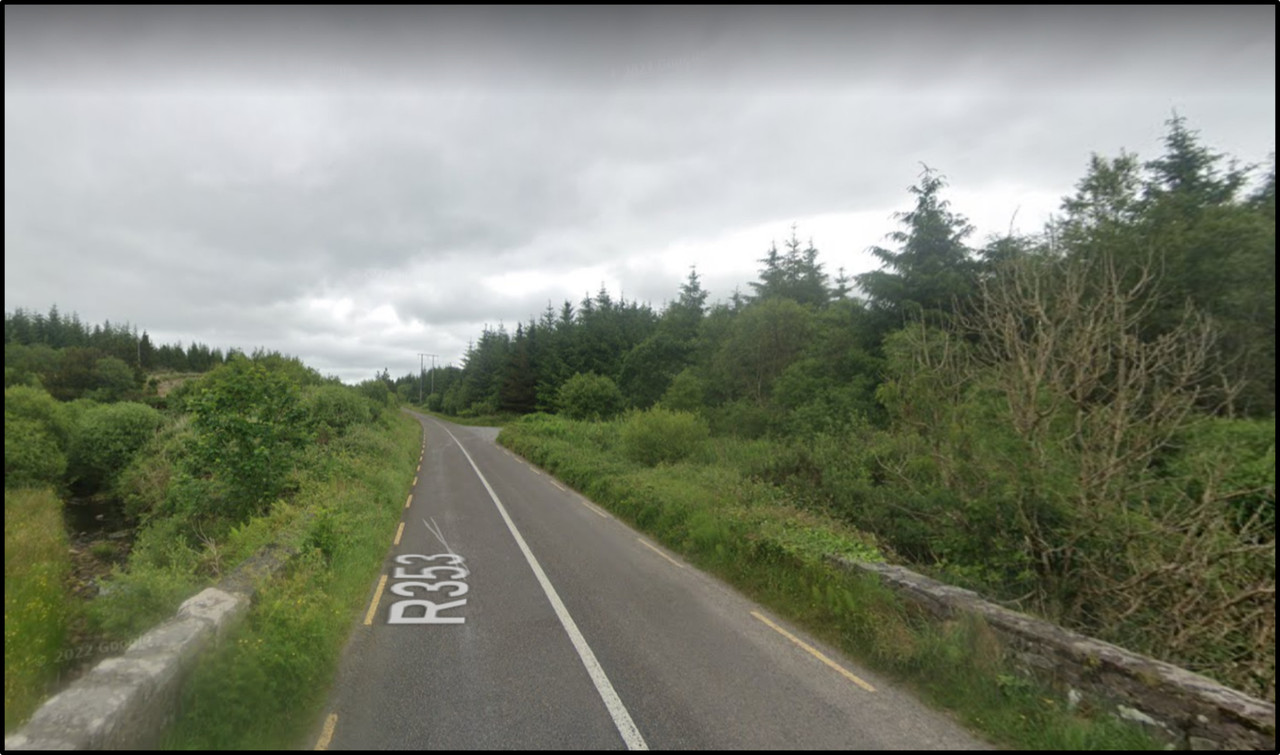
Flaggy Bridge, Derrybrien East

  • Flaggy Bridge … (for ann there is but one liv and hir newbridge is her old)

  • Flaggy Bridge is a road bridge in County Galway, 2.6 km east of Derrybrien on the R353 between Gort and Portumna. Joyce came across the name in the Connacht Tribune.

  • Annie Liffey is an old nickname for the Liffey, probably from the Irish: Abhainn Life, River of Liffey. Personified, she is of course the inspiration for HCE’s wife ALP, or Anna Livia Plurabelle.

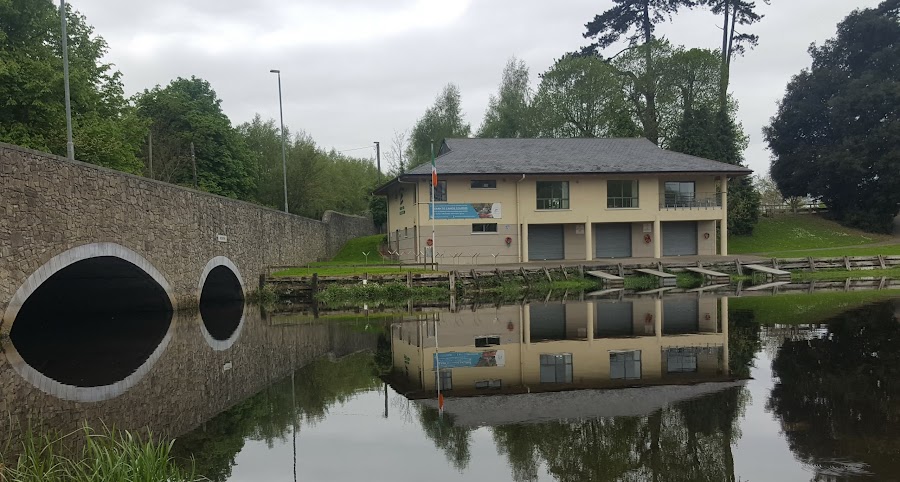
  • The New Bridge was constructed on the Liffey a few kilometres upstream from Leixlip. It was once thought to be the oldest standing bridge in these islands. The original bridge was erected in 1308 by John Le Decer, Mayor of Dublin, at his own expense. It linked the townlands of Coneyburrow and Parsonstown. Originally comprising four arches, it was recently rebuilt with three to facilitate the development of the adjacent water reservoir and the Leixlip hydro-electric dam 2 km downstream, which was constructed in 1945.

  • Shahada: There is no God but Allah and Muhammad is His prophet. This Islamic expression of faith seems out of place following all the denials (nontrue … not at all, man … no such …).


New Bridge, Parsonstown & Coneyburrow

  • to explode his twelvechamber A twelve-chambered revolver. When HCE drew his watch from his pocket during the original Encounter in the Park with the Cad, the action was described as though he were a gunslinger drawing a repeating pistol. A twelve-shot revolver was invented by John Walch in 1859. It only had six chambers, but each chamber could fire two bullets separately. Joyce made a note 12chamber revolver in VI.B.18, a notebook compiled around March–July 1927, but the source is unknown. A story in The Waterford Mail, a provincial Irish newspaper, for 17 January 1870 mentions a twelve chamber revolver, so such guns were known in Ireland. (The same page includes the word Shrievalty in the headline of another story.)

  • Abelbody in a butcherblue blouse Whenever you come across Abel in Finnegans Wake, you should look for Cain. Usually these two brothers, who embody the sibling rivalry between Shem and Shaun, share the same paragraph. In this case, however, when Joyce split this paragraph off from the previous one, he sundered Abel from his brother. Cain can be found on the previous page: that Kane’s fender.

The reference to Abel as a butcher was taken from Thomas Joseph Lamy’s Commentarium in librum Geneseos of 1884. Lamy was a Belgian theologian. Joyce was probably tickled by his surname, which evokes Abel’s lambs:

Scilicet mactaverit Abel in honorem Dei primogenita gregis.

[Of course Abel will have slaughtered the first-born of the flock in honour of God.] ―Lamy 248


A John Walch Twelve Short Revolver

This is the first of several allusions to a blue butcher’s blouse or bishop’s apron (FWEET). The source, I think, is Joseph Walker McSpadden’s Robin Hood and His Merry Outlaws (1923). Chapter III is based on a traditional story in the Robin Hood cycle and has the title:

How Robin Hood Turned Butcher, and Entered the Sheriff’s Service.

In this chapter Robin Hood meets a butcher and exchanges clothes with him:

“One moment more,” laughed Robin, “we must e’en change garments for the nonce. Take mine and scurry home quickly lest the King’s Foresters try to put a hole through this Lincoln green.”

So saying he donned the butcher’s blouse and apron, and, climbing into the cart drove merrily down the road to the town. (McSpadden 34)

This book was originally published as Stories of Robin Hood and His Merry Outlaws in 1904 but it was reissued in 1923, shortly before Joyce first drafted this passage. The reference to a shrievalty entrance―a shrievalty is a sheriff’s office or jurisdiction―only strengthens the allusion. On the previous page of Finnegans Wake we had another instance of HCE swapping clothes with someone he meets: changing clues with a baggermalster (RFW 049.39).

  • butcher blue a dressmaker’s name for a particular shade of dark blue often used for butchers’ aprons.


The Decisive Battle of Waterloo

  • with a most decisive bottle of single in his possession This curious phrase echoes a line from the Museyroom Episode:

This is me Belchum sneaking his phillippy out of his most toocisive bottle of Tilsiter. This is the libel on the battle. Awful Grimmest Sunshat Cromwelly, Looted. (RFW 007.29–31)

The image conjured up is of HCE’s Manservant and bartender Sackerson―Pore ole Joe―sneaking a drink (a fill-up) from a bottle of stout, which is labelled Arthur Guinness, Sons & Company, Ltd. Tilsiter is actually a variety of cheese named for the Prussian city of Tilsit. I presume this innocent foodstuff has been substituted for Pilsener, a popular Bohemian beer. But single suggests that he is drinking something a bit stronger than stout: single malt whiskey. FWEET, however, glosses single as mild ale or beer.

Why is the bottle toocisive or decisive? Note than in this passage bottle has changed places with battle. Waterloo was certainly a most decisive battle. The upshot is that the Battery at the Gate, like Waterloo, is another instance of the Oedipal Encounter that precipitates HCE’s fall from grace.

  • Haveyou-caught-emerod’s temperance gateway HCE. English: emerods, haemorrhoids. In the King James Bible the wicked are sometimes afflicted with emerods.

VI.B.5.001i (May–July 1924) has temperance hotel, accompanied by Joyce’s square siglum, which represented the book, ALP’s Letter, and all containers of HCE: 🞎. HCE’s Mullingar House is no more a temperance hotel than Tilsiter is harmless cheese. This is another example of Sigmund Freud’s dream censor cleaning things up (Freud 121 ff).

A temperance hotel is a hotel in which alcohol is banned. In March 1921 members of Michael Collins’ Twelve Apostles Squad assassinated a British agent as he was coming out of St Andrew’s Temperance Hotel on Exchequer Street.


St Andrew’s House

Another of Dublin’s temperance hotels, the Edinburgh on Upper Sackville Street (O’Connell Street), is mentioned in the Hades Episode of Ulysses.

Cricket

A single is also a cricketing term: a score of one run. This may be an opportune time to take a quick look at this quintessentially English game, which plays a curiously prominent rôle in Finnegans Wake.

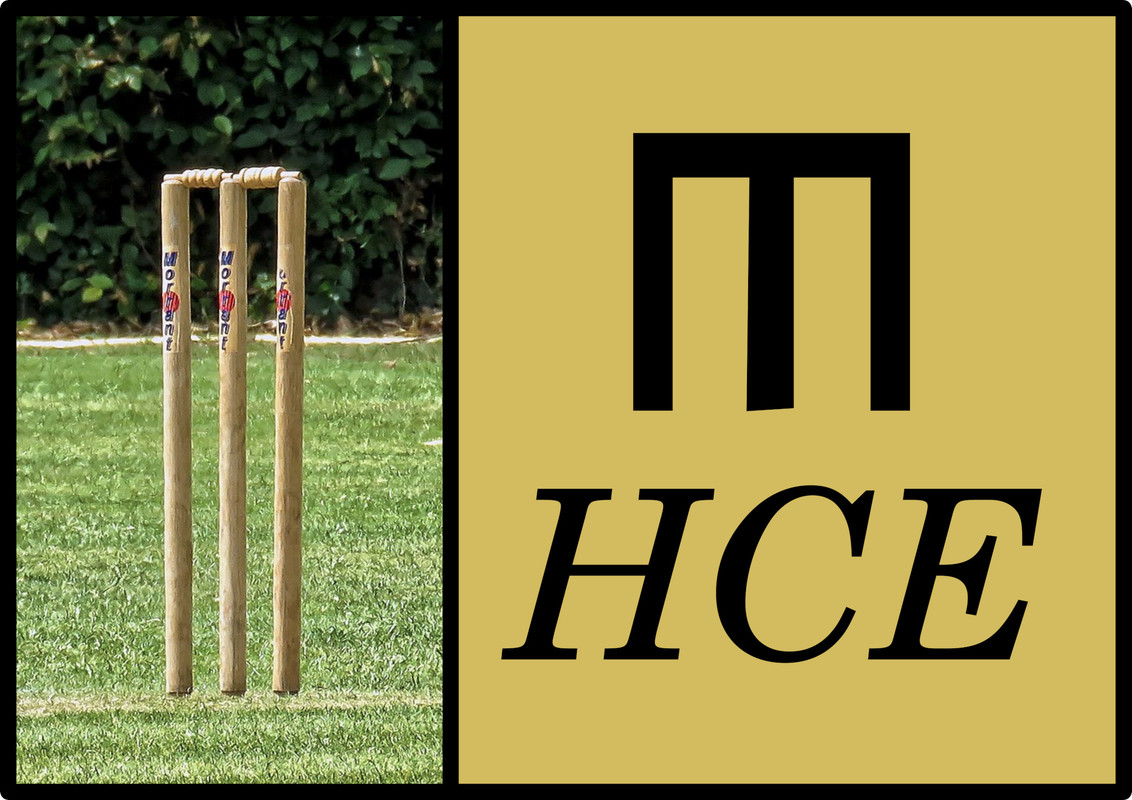
  • batter In his notes Joyce referred to this incident as Batter at Gate (VI.B.1.163, though Rose & O’Hanlon transcribe this as Battery at Gate). If the gate in question was a wicket gate, then batter can only refer to a batsman in cricket. In that game wicket took its name from a wicket gate, which it originally resembled. In its modern form, the wicket closely resembles HCE’s siglum.


A Cricket Wicket & HCE’s Siglum

Unlike most Irishmen, James Joyce loved cricket, and Finnegans Wake is full of allusions to the game. I will probably take a closer look at this aspect of the novel in a future article, but in the meantime I direct the interested reader to Peter Chrisp’s engaging account: James Joyce: Cricket Lover.

And that’s as good a place as any to beach the bark of our tale.


References

Image Credits

Useful Resources
22 June 2023

We Seem to Us


We Seem to Us (RFW 050.19-050:35)

We continue our journalistic investigation into the HCE Affair. The last ten pages of Chapter 3 comprise an episode known as The Battery at the Gate. Following his condemnation in the court of public opinion―as expressed in the Plebiscite―HCE takes refuge within his tavern. But he continues to be abused both verbally and physically. In the chapter-by-chapter outline which Finn Fordham―Reader in 20th Century Literature at Royal Holloway, University of London―prepared for the Oxford World’s Classics edition of Finnegans Wake (2012), the second half of this chapter is summarized thus:

61.28-64.24 HCE took refuge but experienced hostility and a battery at his gate; 64.25-66.9 and the girls? An interludic canoodling in a canoe of a young girl and an older man; conflict is universal; 66.10-67.6 and the letter or coffin (both containers)? 67.7-67.27 A police account in court of the encounter; 67.28-69.29 the two girls again and blackmail; the gate keeping him out of trouble; 69.30-73.27 ‛Battery at the Gate’: a German lodger abuses HCE because he won’t give out any drink; resisting peacefully, HCE simply lists the abusive names he’s called; 73.28-74 HCE has left his mark―now he rests. (Fordham xxxv-xxxvi)

As usual, the same stories are being retold over and over again. Each time new elements are added, but there is always enough to identify them as the old tales with which we are now familiar: HCE’s Oedipal Encounter, and his Crime in the Park. HCE was the offender in the latter, and the defender in the former.


A London Particular

In How Joyce Wrote Finnegans Wake Bill Cadbury, Professor Emeritus of English at the University of Oregon, has made a valiant effort to unravel Joyce’s complicated skein of narrative threads:

The second outrage … centers on an attack at the “gateway” … and this central section of chapter 3 also follows that attack with a defense concerning the girls in the parable … of “a fellow who calls on his skirt” … The core of each section, 3§2 [Be these meer marchant taylors’ fablings …] and 3§3 [Now to the obverse …], is a story of someone at a gate terrorizing HCE within, each derived―3§3 probably and 3§2 demonstrably―from newspaper accounts of criminal proceedings. The 3§2 account is a quite literal re-creation of a comical trial report in the Freeman’s Journal of 21 November 1923, which Vincent Deane has recently discovered and shown to be the origin of six notes in VI.B.11:146-47, from which Joyce crafted the anecdote. The point of the story is a defendant’s claim that he was banging on the gate of a store (which becomes the “Mullingcan Inn” …) in order to open a bottle of stout, a feeble explanation of what was no doubt an attempt to break in and burglarize the store. But Joyce introduced and blended that story with what seems to be a different attack, set somewhere else entirely: “A tall man of his build carrying a suspicious parcel …” … This seems to take place outdoors … and the episode seems designed to recall the cad encounter. (Crispi & Slote 73-74)


Bill Cadbury

Although the latter story was drafted after the Battery proper, it is recounted first―in the very paragraph we are now studying. On FWEET, Raphael Slepon identifies this as the second account of HCE’s Oedipal Encounter:

  • The Encounter in the Park with the Cad with a Pipe (RFW 027.37 ff)

  • The Barkiss Revolver Incident (RFW 050.19 ff)

  • The Herr Betreffender Incident (RFW 056.01 ff)

  • The Incident Hard by the Howe (RFW 064.39 ff))

I would identify it as the third. The first was actually:

  • HCE’s Roadside Encounter with the King (RFW 024.10)

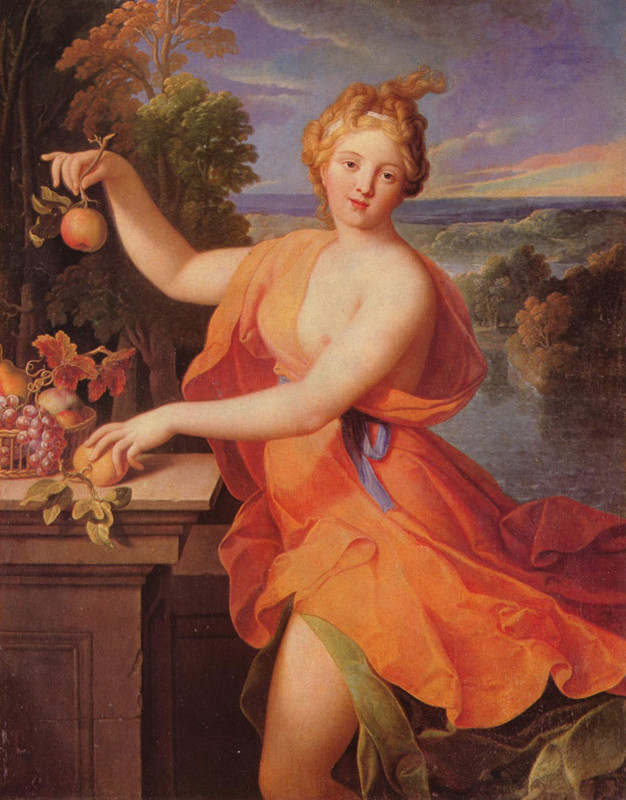
But the references to Lotta Crabtree and Pomona Evelyn also recall the Crime in the Park―HCE’s Original Sin. Crab apple, tree, Pomona and Eve are obvious allusions to the Forbidden Fruit. John Evelyn was a 17th-century gardener. He is best remembered today as a diarist, but he also wrote Sylva, or A Discourse of Forest-Trees and the Propagation of Timber—appropriate, given the context of the Garden of Eden.


 Pomona

And if the composition of this section was a complicated affair, the resulting narrative is perhaps a little less so, as Joseph Campbell & Henry Morton Robinson argue in A Skeleton Key to Finnegans Wake:

Abruptly, now, we are to break out of this tangle of suggestive but not quite clarifying exhibits, and for a while we shall follow a relatively direct narrative: the tale of an encounter, arrest, and incarceration. The encounter comes to us in two versions, and we must judge between them. The entire case resembles that of an American sugar-daddy and his peaches, and so we pause a moment to see a movie version of a love-nest scandal. And the history is complicated by a couple of mysterious episodes: namely, the posting of a certain letter, and the disappearance of a certain coffin. Finally, we shall follow the unhappy later histories of the two women in the case. Nevertheless, through all these complications, the narrative will proceed with relative smoothness, and we shall be able to study, step by step, the progress of the hero. (Campbell & Robinson 73)

In contrast, John Gordon finds the next seven pages quite disorienting (Gordon 133). I concur.


John Evelyn

First-Draft Version

The first draft of what would in time become a paragraph of thirty lines―seventeen in The Restored Finnegans Wake―comprised only a single sentence in the middle of the long paragraph that opened with the words:

Can it be that so diversified outrages were planned and partly carried out against him … [RFW 049.31]

and ran on without interruption to the following line of dialogue:

―You are deeply mistaken sir, let me tell you, denied McPartland. [RFW 054.11]

The first draft reads as follows:

When returning late to the old spot a revolver was put to his face. (Hayman 72)

Here is the same sentence in its original context, with the closing words of what would in time become the preceding paragraph [RFW 050.15-18] and the opening words of what would later be the following paragraph [RFW 050.36]:

Business bred, Humphrey took no chances. Yet he was subject to terror. When returning late to the old spot a revolver was put to his face. But how untrue.


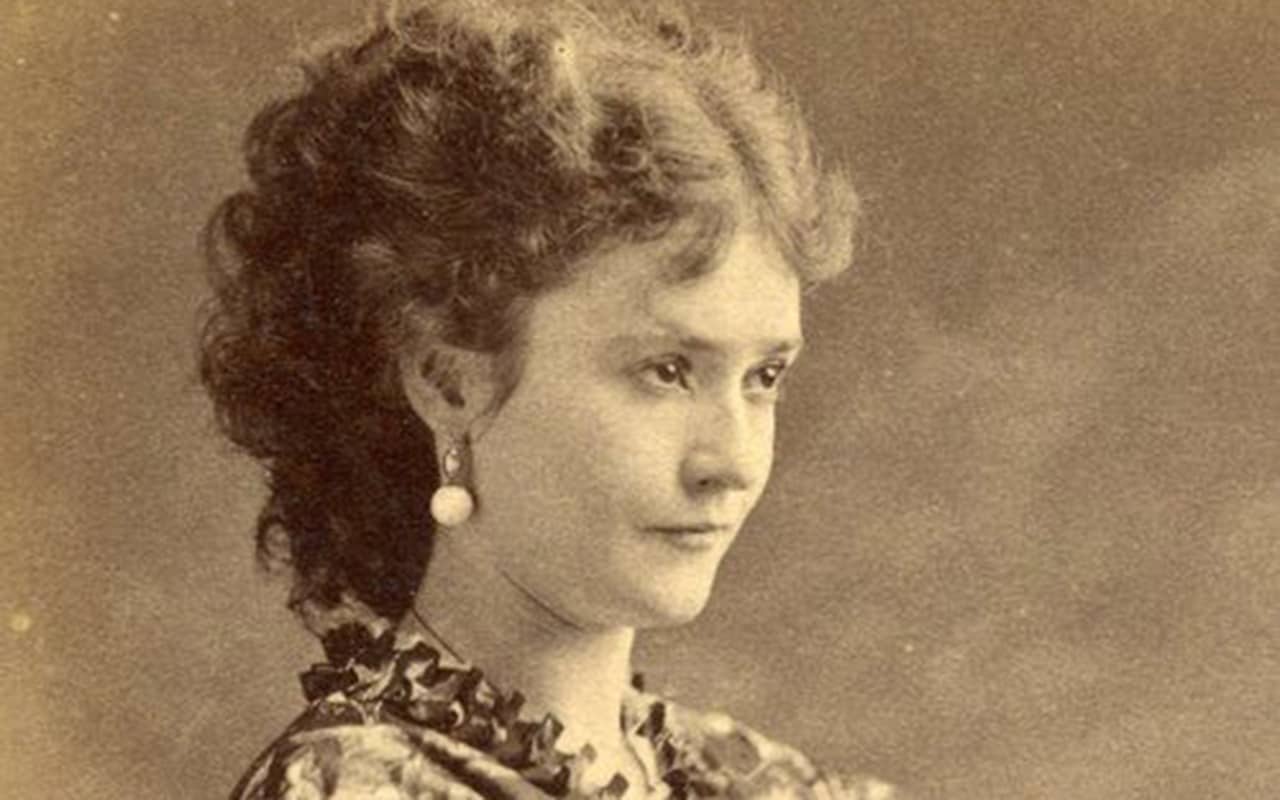
Lotta Crabtree

It is clear, then, that it is HCE who is held up at gunpoint. In the final version, Joyce has obscured the identity of the victim, describing him only as one tall man, humping a suspicious parcel. Perhaps humping gives Humphrey’s identity away, but I think Joyce wanted to emphasize that HCE is both offender and defender, assailant and assailed. As many Joyceans have remarked, HCE is his own worst enemy (collideorscape).

Over the next few years Joyce worked on this passage after his usual manner. In June 1927 a revised draft of this chapter was published in the third issue of Eugene Jolas & Elliot Paul’s literary journal transition. The two principal differences between the first draft and the version in transition are:

  • What would eventually become three separate paragraphs―We seem to us …, But how transparingly nontrue … and Fifthly …―have been set out as a single long paragraph. The first two of these paragraphs were still yoked together when the first edition of the novel was published in 1939, but they were separated by Danis Rose & John O’Hanlon for The Restored Finnegans Wake in 2010. According to the James Joyce Digital Archive, Joyce split this passage into three paragraphs during draft level 8, around 1930-1933.

  • The single line of the first draft has been expanded to twenty-two lines, and is actually very close to the version that would be published in 1939:


transition 3 (Jolas & Paul 41)

Between 1927 and 1939 Joyce made only a handful of minor emendations to this paragraph:

  • you’re shot” became you’re shot, major. Rose & O’Hanlon italicised this line of dialogue. Why does HCE’s assailant address him as major? In the last paragraph HCE changed clothes with a mayor: German: Bürgermeister (RFW 049.39). HCE was previously described as a lordmajor (RFW 023.05). FWEET also notes Ursa Major, the northern constellation of the Great Bear. I find neither of these convincing. In Chapter II.3, The Scene in the Public, HCE is a general when he is shot by Buckley. He must have been promoted.

  • He added two allusions to the Fable of the Ondt and the Gracehoper, which is recounted by Shaun in III.1, The First Watch of Shaun, first drafted in February 1928: the crawsopper … the aunt. Note that the transition version already included the allusions to Cain (Kane’s) and Abel (able), whose sibling rivalry lies behind the fable.

  • He armed the assailant with a cutlass as well as a gun: in edition to Reade’s cutless centiblade. Read & Company were a Dublin firm of cutlers. Their first shop on Lower Exchange Street was established in 1670 by James Read, whose sister Elizabeth was the mother of Arthur Guinness. James’s nephew and successor John Read moved the business to Parliament Street (backing on Crane Lane) in 1750. In 1776 his son Thomas took over the firm, and Dublin’s oldest shop bore the name Thomas Read and Company until 1997, when it finally closed its doors. It is now a café and patisserie called House of Read. Why does Joyce spell Read with a final e? Several Wakean scholars also misspell the name.


Dublin’s Oldest Shop

Freeman’s Journal

Joyce was a passionate reader of newspapers and drew upon them extensively when gathering material for Finnegans Wake. The Freeman’s Journal was one of the papers he regularly read in the early 1920s, when he was living in Paris and at work on his new novel. The prolific Joycean sleuth Vincent Deane discovered the ultimate source of the Battery at the Gate in an article that appeared in the Journal in November 1923:

Richard Whitely, Patrick Farrell, and William Hannon were found guilty at the Commission, charged with having at an early hour of the morning of Sunday, October 7, attempted to break into Pickford’s Store, 6 Upper Sheriff street, with intent to steal goods. It was stated by P.C. Sutton that he and another constable saw the three prisoners at the gate of the store. Hannon was pushing the gate with his shoulder and the others were standing by. When they saw witness they moved to a dark doorway. Whitely was carrying a fender. When witness asked where he got the fender one of the men said “that is for you to find out.” Whitely speaking from the dock, said they were only trying to open a bottle of stout by hammering it against the gate … (Freeman’s Journal 21 November 1923)

The nature of the fender―presumably the source of the suspicious parcel HCE is humping―is never clarified. To me, a fender is a low metal framework in front of a fireplace, but it is hard to imagine a criminal arming himself with such a weapon:


A Fender around a Hearth

But a fender is also anything that serves to fend or keep off something else. Throughout the rest of the Humphriad the nature of this mysterious object metamorphoses. Peter Quadrino, of the Finnegans Wake Reading Group of Austin, Texas, summarizes all these changes in the following passage from his blog Finnegans, Wake!

The attacker at the gate wields a “fender” or some type of a cudgel weapon that morphs and changes appearance throughout chapters 3-4. Details of the story keep changing―there was an attacker banging a bottle at the locked gate, or it was an encounter in the streets with the legless strangler Billy-in-the-Bowl, or there was a no-holds-barred wrestling match with an armed burglar. Joyce intertwines random details from various real-world contemporary newspaper accounts of crimes and trials. Witness accounts vary, “our mutual friends the fender and the bottle at the gate seem to be implicitly in the same bateau” [RFW 052.40 f] it says at one point, while earlier a witness declares “No such parson. No such fender. No such lumber.” [RFW 050.37]. On [RFW 065], the object is made to appear like a crowbar that a burglar and his victim wrestle over: “catching holst of an oblong bar he had and with which he usually broke furnitures he rose the stick at him” [RFW 065.15-16]. On the next page the object could be a Webley revolver pistol, when, in the middle of their “collidabanter” it says “a woden affair in the shape of a webley” [RFW 065.37] falls out of the burglar’s pocket. On [RFW 67 it’s a “humoral hurlbat,” a bat used in the Irish sport of hurling. Later on [RFW 78] the weapon evolves again through rumors and kaleidoscopic views, “Batty believes a baton while Hogan hears a hod yet Heer prefers a punsil shapner and Cope and Bull go cup and ball.” The presence of bat and ball suggest cricket and/or baseball references here, but more on that in a moment.

As discussed in my last post, in the book Wake Rites, George Cinclair Gibson describes the “Batter at the Gate” confrontation as paralleling certain rituals of the ancient Irish druids. One of these rituals, which were designed to divest the old king of his powers, apparently included a hostile druid confronting the king at a doorway while aggressively wielding the wooden “shamanistic device” known as a bull-roarer. Gibson gives a good argument for the mysterious wooden object in this part of the Wake being a bull-roarer (see Wake Rites, p. 88-90 [Page 109]) and notes that J.S. Atherton in his Books at the Wake observed that Joyce definitely knew about this druid device. (Finnegans, Wake!)


Freeman’s Journal & Connacht Tribune

Fender could also be an abbreviation. In the Oxford English Dictionary, fender is given as a synonym for defender, though this is flagged as Obsolete except dialectal (OED). But fender could just as easily be short for offender. Joyce revels in the ambiguity. HCE is both offender and defender.

Connacht Tribune

Another of Joyce’s favourite newspapers in the early 1920s was the Connacht Tribune. It was in the edition for 17 May 1924 that he borrowed the incident with the revolver, which will be revisited in the next chapter (RFW 064.39 ff). The incident referred to occurred in Galway in 1923. The following passage is relevant to the paragraph we are now studying:

John Keogh in the Dock … Another Killimore Raid. Another charge of raiding Killimore barracks on 18th October, 1923, when the guards’ uniforms and bicycles were carried away and Sergeant Keely and other guards were beaten, was next proceeded with. Sergeant Keely, describing the raid, said he remembered the morning of the 18th. He heard knocking at the door and he asked who was there. The reply came, “The boys.” He opened the door and he was forced back with two revolvers by Jack Downey and Jack Keogh … Keogh … pointed a revolver at Guard Temple saying, “You’re shot,” firing at the same time, and the bullet went through the bedroom window. (Connacht Tribune 17 May 1924)

In Ireland the boys commonly refers to members of the IRA.


Killimore, County Galway

Killimor, or Killimore, is a town in the east of County Galway:

The Barracks: According to both the 1901 and the 1911 census this was originally a dwelling house with nine rooms and owned by the Rudden family. Matthew Rudden was an RIC [Royal Irish Constabulary] pensioner and his daughter, Clarry Rudden, married John Taylor, an auctioneer, in Portumna. The building was then used as a barracks by the Garda Síochána until the construction of the new barracks. It was then bought by members of the Cunniffe family. (Killimor Town in the Past)

Note that the present paragraph opens with We seem to us … to be reading, which implies that the following account of the assault is a written report of some kind―such as one might come across in a newspaper.

Locations

Although Joyce based the assault on an incident that took place in Killimore, County Galway, he sets it elsewhere:

… after the show at Wednesbury … returning late amid a dense particular … from the second house of the Boore and Burgess Christy Menestrels by the old spot, Roy’s Corner …


Bridge Street, Wednesbury

Wednesbury is a market town in Staffordshire, England. Why did Joyce choose this particular place? Was it because the name incorporates both space and time―Wednesday? Note that HCE later addresses his assailant as Midweeks. German: Mittwoch, Wednesday (literally: Midweek). Louis O Mink notes that Wednesbury was the site of a battle between the Saxons and Britons in 592 CE. This is taken from the Anglo-Saxon Chronicle, but the identity of Woden’s Barrow is disputed (Mink 535 : Swanton 20 and fn 4). According to FWEET, Joyce’s source for Wednesbury was Alfred Robbins’ Parnell: The Last Five Years:

But, in addition to Campbell, there was a source of Information special to myself In the person of Philip Stanhope, long afterwards Lord Weardale, the Radical member of a Conservative family―brother of Salisbury’s Secretary for War at the very time―who was then sitting for Wednesbury. (Robbins 171)

Joyce is unlikely to have known about the alleged battle between the Saxons and Britons. Even if he looked up Wednesbury in the Encyclopædia Britannica he would not have found any mention of this battle.


Scene of the Murder of Percy Thompson in Ilford, London

The dense particular suggests that the scene is set somewhere in London. The Bywaters Affair, which inspired the HCE Affair, took place in Ilford, in the northeast of London. Percy Thompson was murdered by Frederick Bywaters when he and his wife were returning home from a show at the Criterion Theatre in Piccadilly. In the present situation, however, the show is a minstrel show. In this genre Moore & Burgess were rivals of Christy’s Minstrels. Joyce’s notes suggest that the second house is Israel, or the period of Jewish history when the Second Temple stood. Presumably Joyce is drawing parallels between HCE’s persecution and historical instances of the persecution of Blacks and Jews.

The old spot is surely the scene of HCE’s Crime in the Park. It is a commonplace that criminals always return to the scene of the crime. Does the phrase also recall the Old Sots’ Hole [RFW 033.12], the pub where Hosty and his mates wet their whistles before launching Hosty’s Rann on the unsuspecting populace of Dublin?

Roy’s Corner (French: roi, king) reminds us that HCE’s first Oedipal Encounter in the Humphriad was his meeting with the King on the road outside his tavern (RFW 024.10 ff). In A Finnegans Wake Gazetteer, Louis O Mink comments:

ROY’S CORNER This sounds like a real name in Dublin popular usage, but no one seems to remember it. In the later 19th century, George Roy’s fish stores were at the corner of George’s St, East, and George’s Quay, Upper. The name might be a pun on “King’s Corner,” and W King, printer and stationer, was at the corner of Charles St and Ormond Quay, Upper. (Mink 471)


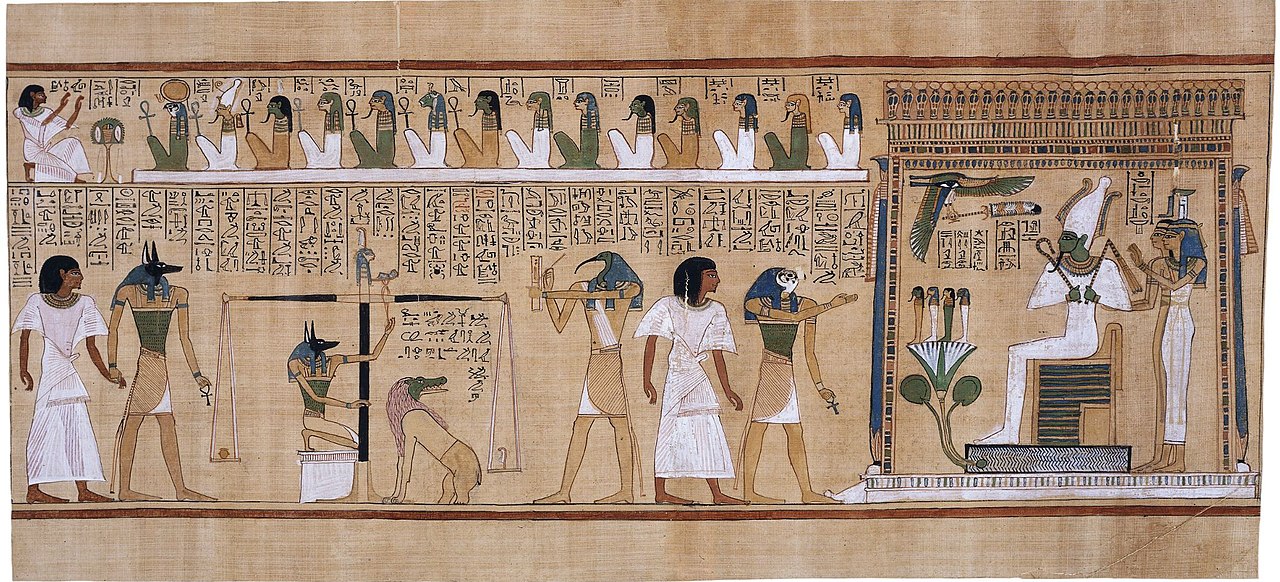
The Judgement of the Dead in Amenti

The Book of the Dead

In The Books at the Wake, James Atherton identifies the Ancient Egyptian Book of the Dead as one of the sacred books of Finnegans Wake. He devotes an entire chapter―ten pages―to it, noting that Joyce’s friend Frank Budgen was the first to identify it as an important source for Finnegans Wake (Atherton 191-200):

The text which is cut or written on figures from the XIIth dynasty onwards explains quite clearly the purpose the figures were intended to serve, for in it the figure is called upon, in the name of the deceased person written upon it, to perform whatever labours he might be adjudged to do in the other world [Budge 216]. The sixth chapter is mentioned later in ‛We seem to us (the real us!) to be reading our Amenti in the sixth sealed chapter of the going forth by black’ [RFW 050.19-20]. One meaning of this is that we are being sentenced to an eternity of punishment or labour as Shabti figures. ‛Amenti’ is an Egyptian word meaning both the World of the Dead and the West. Perhaps ‛the sixth sealed’ is also an allusion to the six seals which were found on the tomb of Tutankhamen, to which much publicity was given between 1922 and 1927. Joyce uses the phrase ‛Us, the real Us’ twice [RFW 050.19 and 346.37]; it translates nuk per nuk, ‛I, even I’, in the royal plural as it was used by the Pharaohs in their inscriptions. (Atherton 194-195)


I, Even I

Joyce’s source for the details he uses in the present paragraph was Tom Tit Tot: An Essay on Savage Philosophy in Folk-Tale, by the English anthropologist Edward Clodd. In a chapter entitled Words of Power, under the heading Passwords, we read:

The famous Word of Power, ‘Open, Sesame,’ pales before the passwords given in the Book of the Dead, or, more correctly, The Chapters of Coming Forth by Day. This oldest of sacred literature, venerable four thousand years B.C., contains the hymns, prayers, and magic phrases to be used by Osiris (the common name given to the immortal counterpart of the mummy) in his journey to Amenti, the underworld that led to the Fields of the Blessed. (Clodd 205)

Joyce borrows from this book on at least nine occasions in the course of Finnegans Wake: FWEET.


Edward Clodd

Barking Mad

The innocent word barkiss is full of meaning and is a good example of how many layers of subtext Joyce can squeeze into a single word:

  • Barkiss This is a genuine surname, but I don’t think Joyce had any particular Barkiss in mind. The name does not appear in Adaline Glasheen’s A Third Census of Finnegans Wake.

  • Slang: barker, pistol.

  • Mr Barkis A character in Charles Dickens’ novel David Copperfield, who constantly informs his beloved Clara Peggotty that Barkis is willin’ (ie willing to marry her). The phrase has become proverbial as an indication of a person’s willingness to do something. In this case, the assailant is willing to kill HCE.

  • Burgess Moore & Burgess Minstrels are alluded to in the previous line.

  • Berkeley The Irish philosopher and clergyman George Berkeley. In the final chapter of Finnegans Wake he will appear as the Archdruid of Ireland, who suffers an Oedipal Encounter with the invader St Patrick.

  • Burke Edmund Burke, the Irish Parliamentarian, who once quoted King Lear in the House of Commons: See, they bark at me (Benjamin 675).

  • Buckley The sniper who assassinates HCE during the Crimean War, as recounted in How Buckley Shot the Russian General (RFW 260.32 ff). This is yet another re-enactment of HCE’s Oedipal Encounter with the Cad.

  • Barkey An Anthony Barkey was Lord Mayor of Dublin in 1717-1718.

  • Barkers A department store in Kensington, London (1870-2006), though I doubt they ever sold revolvers.


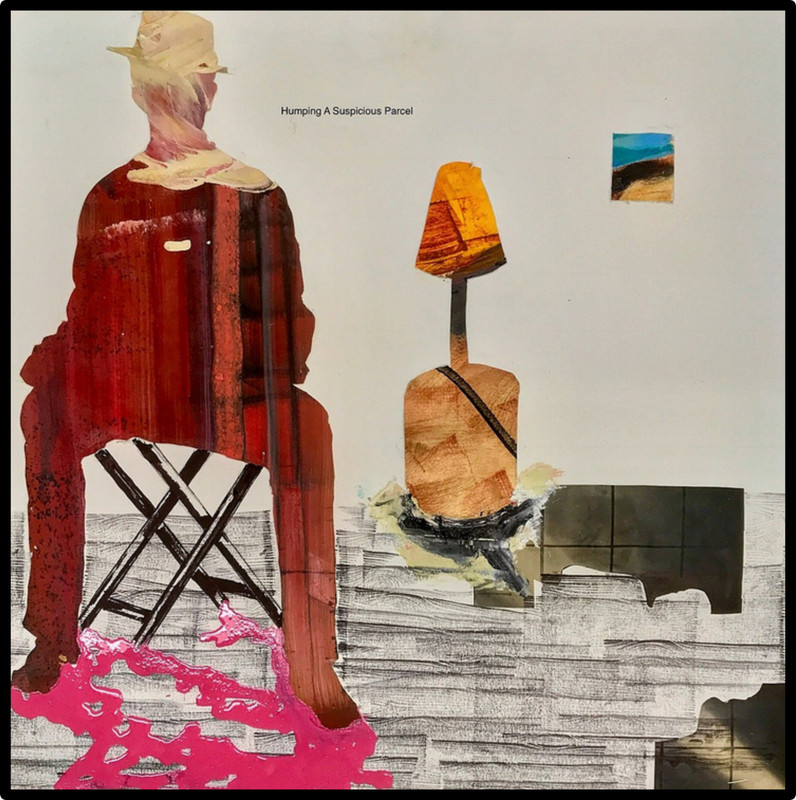
Humping a Suspicious Parcel

Weather

To conclude, note the changeability of the weather, which is a recurring motif in this chapter. Bad weather and poor visibility are metaphors for the difficulty of separating fact from fiction:

going forth by black … amid a dense particular … hailing … gaelish … blizzard’s … sultry … showery …

And that’s as good a place as any to beach the bark of our tale.


References

  • James S Atherton, The Books at the Wake: A Study of the Literary Allusions in James Joyce’s Finnegans Wake, The Viking Press, New York (1960)
  • Roy Benjamin, Noirse-Made-Earsy: Noise in Finnegans Wake, Comparative Literature Studies, Volume 50, Number 4, Pages 670-687, Penn State University Press, University Park, Pennsylvania (2013)
  • Joseph Campbell, Henry Morton Robinson, A Skeleton Key to Finnegans Wake, Harcourt, Brace and Company, New York (1944)
  • Edward Clodd, Tom Tit Tot: An Essay on Savage Philosophy in Folk-Tale, Duckworth and Co, London (1898)
  • Finn Fordham (editor), Chapter by Chapter Outline, Finnegans Wake, Oxford World’s Classics, Oxford University Press, Oxford (2012)
  • George Cinclair Gibson, Wake Rites: The Ancient Irish Rituals of Finnegans Wakes, University Press of Florida, Gainesville (2005)
  • John Gordon, Finnegans Wake: A Plot Summary, Syracuse University Press, Syracuse, New York (1986)
  • David Hayman, A First-Draft Version of Finnegans Wake, University of Texas Press, Austin, Texas (1963)
  • Eugene Jolas & Elliot Paul (editors), transition, Number 3, Shakespeare & Co, Paris (1927)
  • James Joyce, Finnegans Wake, The Viking Press, New York (1958, 1966)
  • James Joyce, James Joyce: The Complete Works, Pynch (editor), Online (2013)
  • Terence Killeen, The Boarder Incident Prerepeated Itself: A Study in Conflict, Aurora Piñeiro (coordinator), Rewriting Traditions: Contemporary Irish Fiction, Pages 61-75, Universidad Nacional Autónoma de México, Mexico City (2021)
  • Louis O Mink, A Finnegans Wake Gazetteer, Indiana University Press, Bloomington, Indiana (1978)
  • Alfred Robbins, Parnell: The Last Five Years, Thornton Butterworth, Ltd, London (1926)
  • Danis Rose, John O’Hanlon, The Restored Finnegans Wake, Penguin Classics, London (2012)
  • Michael J Swanton (translator & editor, The Anglo-Saxon Chronicle, Routledge, New York (1998)

Image Credits

Useful Resources
For in those deyes

  The Sacrifice of Isaac : The Green Woods of Truagh The last ten pages of Chapter 3 of James Joyce’s Finnegans Wake comprise an episode ...