25 April 2024

Humphrey's Unsolicited Ad Hock Visitor


O, By the By (RFW 056.19–056.37)

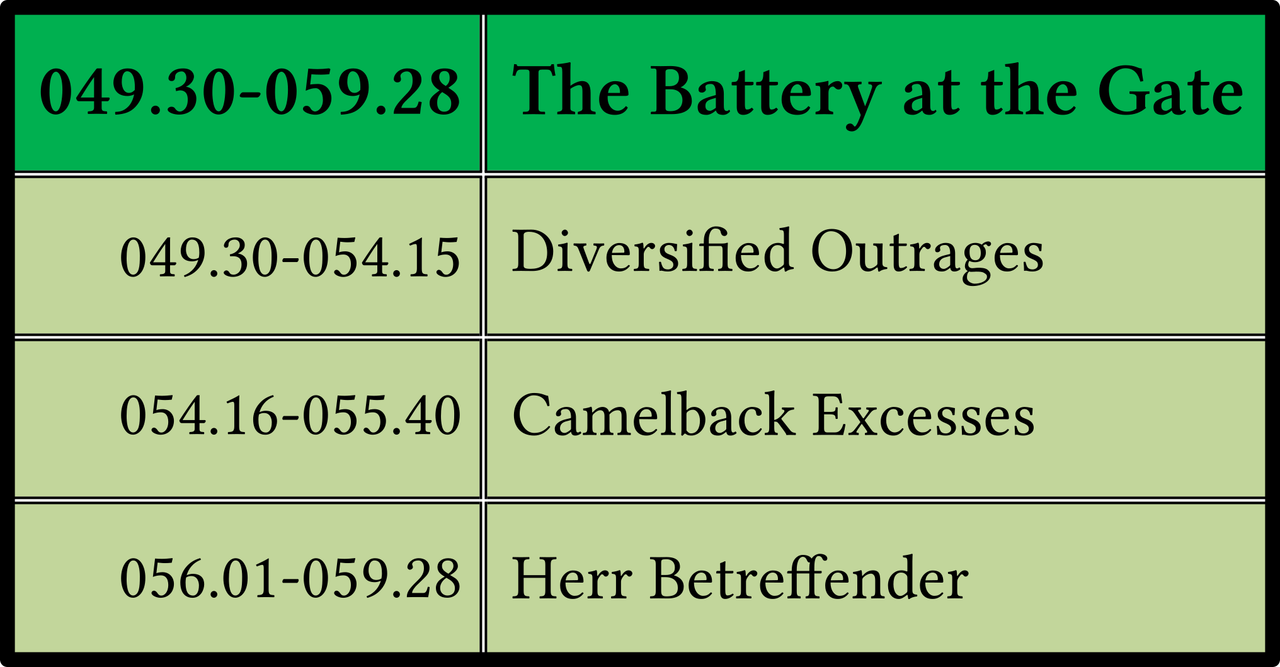
The last ten pages of Chapter 3 of James Joyce’s Finnegans Wake comprise an episode known as The Battery at the Gate. The third and final section of the Battery, Herr Betreffender (RFW 055.01–059.28), is yet another account of the Oedipal Event. In the previous paragraph HCE suffered an assault at the hands of an Austrian salesman, who was spending his summer holidays as a guest in HCE’s inn. Believing that the landlord has relieved him of a sum of money and rifled the pockets of his overcoat, he proceeded to batter on HCE’s gate and demand retribution. In the present paragraph this individual has unexpectedly morphed into an American, but continues to press home his attack at the gate of HCE’s establishment.

In the first edition of Finnegans Wake (1939), this metamorphosis takes place abruptly in the middle of a paragraph, but in The Restored Finnegans Wake (2010) Danis Rose & John O’Hanlon have reinstated a paragraph break between the Austrian and American incarnations of HCE’s attacker. This paragraph break was introduced by Joyce at draft-level 8 but disappeared when the book was being typeset.

First-Draft Version

The first draft of this passage followed the previous section without a break and consisted of just two sentences:

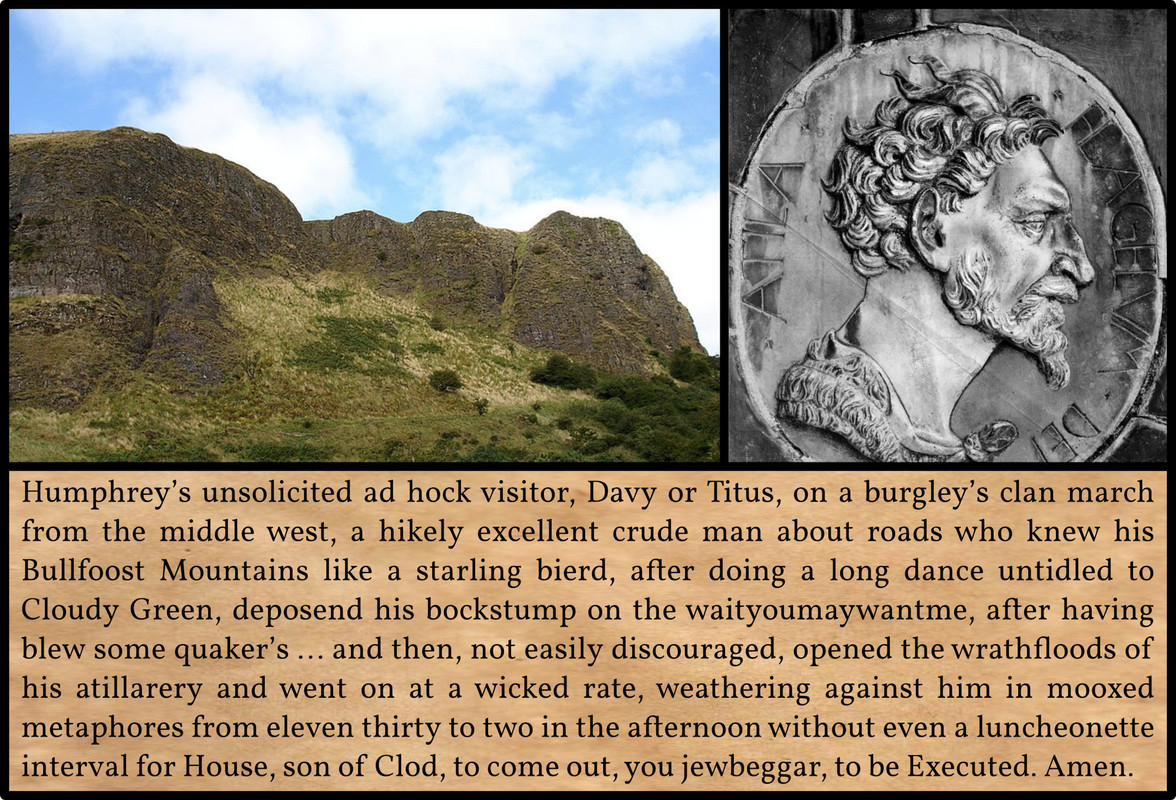
Humphrey’s unsolicited visitor said through the gate first that he would break his head next that he would then break the gate over his head and finally give him his (Humphrey’s) blood to drink. He kept abusing him from ten thirty till one in the afternoon without a lunch interval. ―Hayman

Bock

In expanding this to half a page, Joyce not only Americanized HCE’s assailant but also elaborated the food-and-drink motif that was already present in the first draft. The second draft altered the second sentence to read:

He demanded drink and kept abusing him …

In the real world of Finnegans Wake―insofar as there is a real world in Finnegans Wake―it is possible that the whole incident of the Battery at the Gate is simply a dreamlike episode conjured up in the mind of the sleeping landlord of the Mullingar House by the noise of a late-night reveller, who has arrived at the pub after closing time and is battering on the door, demanding drink. This would account for the prominence given to food and drink in the final version of this paragraph.

  • bockstump German: Bock, a dark German lager : French: bock, glass of beer : a beer glass. Bock is the German for ram, which may account for bleated two lines below.

  • some quaker’s (for you! Oates!) Quaker Oats, an American company famous for its oatmeal or porridge. Titus Oates was an English Anglican priest who fabricated the Popish Plot in 1678, alleging that several prominent Catholics were conspiring to assassinate Charles II. Among those named was Peter Talbot, Archbishop of Dublin. Titus was also the nickname of Lawrence Oates, who accompanied Robert Scott to the South Pole in 1912. He famously walked out of the tent in a blizzard, saying: I am just going outside and may be some time. He was never seen again. The Irish Antarctic explorer Ernest Shackleton was a Quaker.


Titus Oates & Quaker Oats

  • heeltapper a heeltap is a small amount of drink (especially alcoholic) remaining at the bottom of a glass.

  • stirabouter In Ireland porridge was once popularly known as stirabout, though the term is rarely heard nowadays. Joyce used it in this sense in The Dead. The Oxford English Dictionary describes the word as Originally Anglo-Irish. The word also means a bustling person.

  • thickerthanwater (Proverbial) Blood is thicker than water, meaning that familial ties are stronger than other relationships, such as those between friends or colleagues. The Blood of Christ is drunk during the Catholic Mass, an example of the Mastication of the Host, an important leitmotif in Finnegans Wake.

  • steppebrodhar Danish: brød, bread. Coming immediately after the reference to blood, this bread is clearly the Body of Christ. For the other elements in this word see below.

  • wood alcohol Methanol or methyl alcohol. This is highly toxic (taxis) to humans, and even small amounts can cause permanent blindness, so it can hardly be described as a drink. But alcohol generally refers to the closely related chemical ethanol, which is the active ingredient in potable alcohol.

  • his isbar HCE’s stuttering attempt at his bar. Also Russian: izba, cottage : Polish (archaic): izba, room. In Finnegans Wake stuttering is a sign of guilt.

  • public a pub or public house. Joyce referred to Chapter II.3 as The Scene in the Public.

  • oven

  • sake Japanese: sake [酒], alcoholic beverage : rice wine. It is traditionally served in a rectangular wooden vessel called a masu.

  • irsk irskusky Irish whiskey : Irish: uisce, water. More stuttering.

  • luncheonette a small diner that serves lunch


Japanese Sake

Shem & Shaun

The Battery at the Gate is another telling of the Oedipal Event, in which HCE is confronted by a younger man embodying his two sons, Shem & Shaun. John Gordon is probably right, then, when he detects traces of HCE’s sons in Herr Betreffender. As I have pointed out before, Shem is often associated with Australia and Shaun with America. Australia is a hot and hellish underworld, an appropriate place for the diabolical Shem : America is the Promised Land, making it a suitable abode for the angelic Shaun. If we take Austria [Eastern] as a dream-distortion of Australia [Southern], then we can begin to see why Herr Betreffender’s nationality changes during this episode. He embodies both sons.

Gordon also believes that the door of the master bedroom in the Mullingar House is the focal point of Shem & Shaun’s Oedipal threat to their father. While HCE and ALP are locked in sexual congress―conceiving Issy?―the two brothers are at the door trying to spy on them and figure out just what it is that mummies and daddies do behind closed doors. Shaun, whose eyesight is good, is peering through the keyhole : Shem, whose hearing is good, is listening at the door.

Shem & Shaun are the quintessential sibling rivals. As such they are often played in Finnegans Wake by a mythical or historical pair of warring twins: Romulus & Remus, Cain & Abel, Jacob & Esau. Sometimes they appear as rivals who were not actually brothers, but closely related in some other fashion: Brutus & Cassius, for instance.

In this paragraph we have an example of each: Attila & Bleda : Brian Boru & Brodir:

his bleday steppebrodhar … his atillarery
 

The Death of Attila

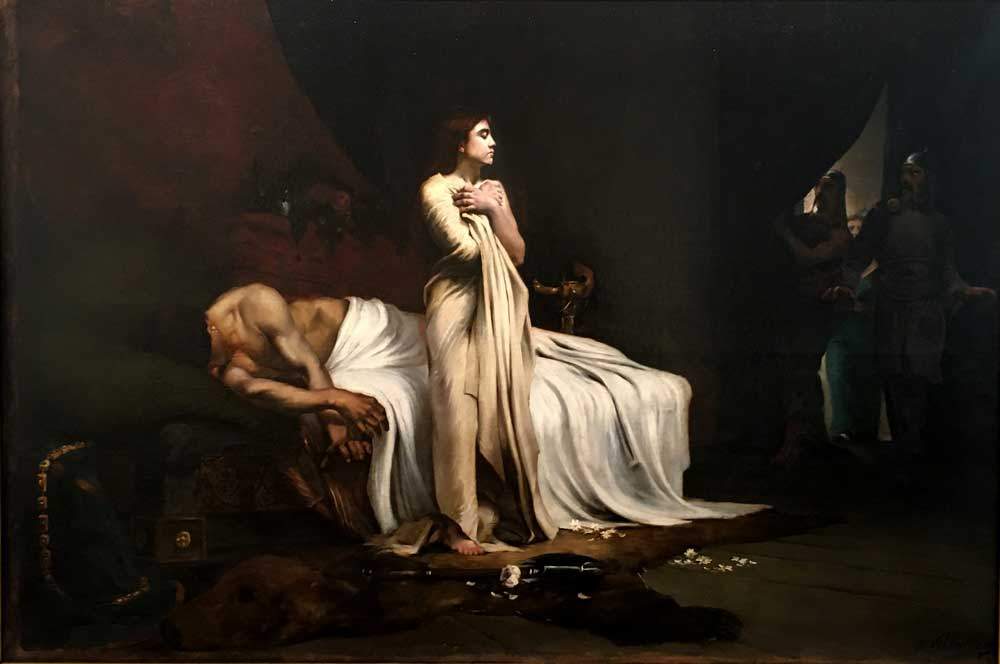
Attila the Hun needs no introduction. In the 5th century this warlord from the steppes of Central Asia led the Huns into Europe and threatened to conquer Roman Gaul, before being halted at the Battle of the Catalaunian Fields in 451. The latter, you may recall, was alluded to on the opening page of Finnegans Wake (oystrygods gaggin fishygods, referring to the fact that in the battle the Ostrogoths sided with Attila and the Visigoths with Rome). Attila and his elder brother Bleda succeeded their uncle Rugila and ruled jointly over the Huns from 435 until the death of Bleda in 445. By all accounts there was no love lost between the two. It is alleged that Attila killed Bleda after Bleda tried to kill him. Attila, himself, is said to have died on his wedding night after a day of excessive drinking, so he is quite at home in the pages of Finnegans Wake.

Brodir was the name of a Norse warlord who took part in the Battle of Clontarf, outside Dublin, in 1014. This battle was the culmination of a revolt against Brian Boru, High King of Ireland, by Máel Mórda mac Murchada, King Leinster, and Sitric Silkenbeard, King of Dublin. According to tradition, Brodir and Brian met on the battlefield and died at each other’s hands. By a happy coincidence, Brodir had a brother, Ospak of Man, who fought on Brian’s side at Clontarf.

Note that the Oedipal Figure can also be recognized as HCE himself, who is, as usual, his own worst enemy. This is indicated explicitly by the description of the visitor as a hikely excellent crude man, which encodes the familiar HCE initialism. At the end of this paragraph we have further confirmation of this close relationship between offender and defender:

House, son of Clod, to come out, you jewbeggar, to be Executed.
Music Again

Like the preceding paragraph, this one contains a cluster of allusions to Irish songs taken from Charles Villiers Stanford’s Complete Collection of Irish Music as Noted by George Petrie. FWEET identifies seven titles:

  • clan march Ancient Clan March

  • a hikely excellent crude man about road The highly excellent good man of Tipperoughny

  • his Bullfoost Mountains The Belfast Mountain

  • a starling bierd Alas, that I’m not a little starling bird

  • a long dance Long Dance

  • Cloudy Green Adieu ye young men of Claudy green. Claudy or Clady is a village in County Derry.

  • the tairor of his clothes The taylor of the cloth

Finally, two honorary mentions:

  • the houseking’s … crack a nut E T A Hoffmann’s Christmas tale The Nutcracker and the Mouse King was famously set to music by Tchaikovsky as his ballet The Nutcracker.

  • his granfather’s My Grandfather’s Clock, a popular American song by Henry Clay Work.


Charles Villiers Stanford & George Petrie

Buckley & Kersse

In Chapter II.3, The Scene in the Public, two epic reenactments of the Oedipal Event will take place:

  • How Kersse the Tailor Made a Suit of Clothes for the Norwegian Captain

  • How Buckley Shot the Russian General

Both of these are very briefly foreshadowed in the present paragraph:

a burgley’s … the tairor of his clothes … the hirsuiter

Although the assassination of the Russian General during the Crimean War is not specifically mentioned here, we do have the following allusion to Russian politics:

… he would break his bulsheywigger’s head for him …

  • bulsheywigger’s Bolshevik’s

Davy or Titus

In this paragraph HCE’s visitor is identified as Davy or Titus. Who do these names refer to?

FWEET suggests that Davy is Humphry Davy, the English chemist who invented the Davy lamp. This Davy is mentioned immediately after Humphrey’s, so who knows? But Adaline Glasheen notes that David, by way of the Welsh St David, becomes Taff (Glasheen 44, 69). Butt & Taff are the two soldiers who reenact How Buckley Shot the Russian General in the Crimea. In the same line as Davy we have a clear allusion to Buckley (burgley’s), so this seems more likely than Humphry Davy.


Titus & Domitian

Glasheen also suggests that Titus refers to the eponymous hero of Titus Andronicus, Shakespeare’s melodramatic drama. This play features cannibalism, which could feed into the food-and-drink theme in this paragraph. Titus Oates also includes a foody element in his surname.

FWEET once again disagrees, suggesting that Titus refers to the Roman Emperor (the umperon’s) Titus Vespasianus. The latter had a younger brother, Domitian, who succeeded him. There is no evidence that the brothers ever quarrelled or threatened their father Vespasian. But Domitian was embarrassed enough by his baldness to wear a wig (busheywigger’s).

Closing Time

The original draft of this paragraph already included a timestamp:

He kept abusing him from ten thirty till one in the afternoon without a lunch interval.

This supports the hypothesis that someone is banging on the door of the Mullingar House after closing time. According to the Intoxicating Liquor (General) Act, 1924, the closing time on weekdays was 10 o’clock. In the final version, HCE’s attacker claims that the clock is fast―a common practice in Irish pubs―and that it is just gone 10 o’clock:

alleging that his grandfather’s was all taxis and that it was only after ten o’connell

  • grandfather’s My Grandfather’s Clock

  • taxis Ancient Greek: ταχύς (tachýs), fast. Compare this with the Cad Encounter, where the Cad complains that his watch is bradys: Ancient Greek: βραδύς (bradús), slow (RFW 028.16).

  • o’connell O’Connell’s Dublin Ale, brewed by The Phoenix Brewery in James’s Street, Dublin. The brewery was once owned by Daniel O’Connell, son of the Liberator. It is not to be confused with the Phoenix Park Distillery in Chapelizod, where Joyce’s father worked for a time.


The Phoenix Brewery, Dublin

In the final version Joyce has also altered the times between which HCE’s attacker berates him:

and went on at a wicked rate, weathering against him in mooxed metaphores from eleven thirty to two

Here we have the familiar 1132, which symbolizes the Fall and Resurrection of Man in Finnegans Wake.

  • mooxed metaphores Not only mixed metaphors (French: métaphores, metaphors) but also an allusion to yet another version of the Oedipal Event: Shaun’s parable of The Mookse and the Gripes in I.6, The Quiz. The matching gripes is at RFW 058.05.

And that’s as good a place as any to beach the bark of our tale.


References

Image Credits

  • Cave Hill, Belfast Mountains: © Donna (photographer), Creative Commons License
  • Attila the Hun: Louvre Museum, Paris, Public Domain
  • Bock: Calvert Lithographing Company, Detroit, Michigan : Library of Congress, Prints & Photographs Division, Washington, DC (1882), Public Domain
  • Titus Oates: Godfrey Kneller (artist), University of Cambridge, Cambridge, England, Public Domain
  • Quaker Oats: Miami University Library, Digital Collections, Public Domain
  • Japanese Sake: The Epopt (photographer), Public Domain
  • The Death of Attila: J. Villeclère (artist), Musée des Beaux-Arts de Nice, Nice, France, Public Domain
  • Charles Villiers Stanford: Alexander Bassano (photographer), National Portrait Gallery, London, Public Domain
  • George Petrie: The Journal of the Royal Society of Antiquaries of Ireland, Volume 46 (Consecutive Series), Plate V, Dublin (1917), Public Domain
  • Titus: Daderot (photographer), Galleria Borghese, Rome, Public Domain
  • Domitian: Castro Pretorio (photographer), National Archaeological Museum, Naples, Public Domain
  • The Phoenix Brewery, Dublin: Alfred Barnard, The Noted Breweries of Great Britain and Ireland, Volume 3, Page 68, Sir Joseph Causton & Sons, London (1890), Public Domain

Useful Resources

04 March 2024

O, By the By


O, By the By (RFW 056.01–056.18)

The last ten pages of Chapter 3 of James Joyce’s Finnegans Wake comprise an episode known as The Battery at the Gate. This paragraph opens the third and final section of the Battery, Herr Betreffender (RFW 055.01–059.28), in which HCE suffers an assault at the hands of an Austrian salesman on his summer holidays. As usual, this is just another retelling of the same old story of HCE’s roadside encounter with the King, which was also retold as an encounter in the Phoenix Park with the Cad with a Pipe.

First-Draft Version

This paragraph began life as a pair of sentences in the middle of a long paragraph, which Joyce later expanded to fill more than four pages of The Restored Finnegans Wake (RFW 055.19–059.28). Herr Betreffender was originally an unnamed travelling salesman, who was staying as a guest at HCE’s tavern. He attacks the gate―the Battery at the Gate―believing that HCE has robbed him of some cash and rifled the pockets of his overcoat:

It ought to be always remembered that there was a commercial stopping in the hotel and he missed six pounds fifteen and he found his overcoat disturbed. The gate business was all threats & abuse. ―Hayman 74

These details were inspired, once again, by a story Joyce read in one of his favourite newspapers, the Connacht Tribune:

FOND OF FINERIES Young Girl Returned for Trial

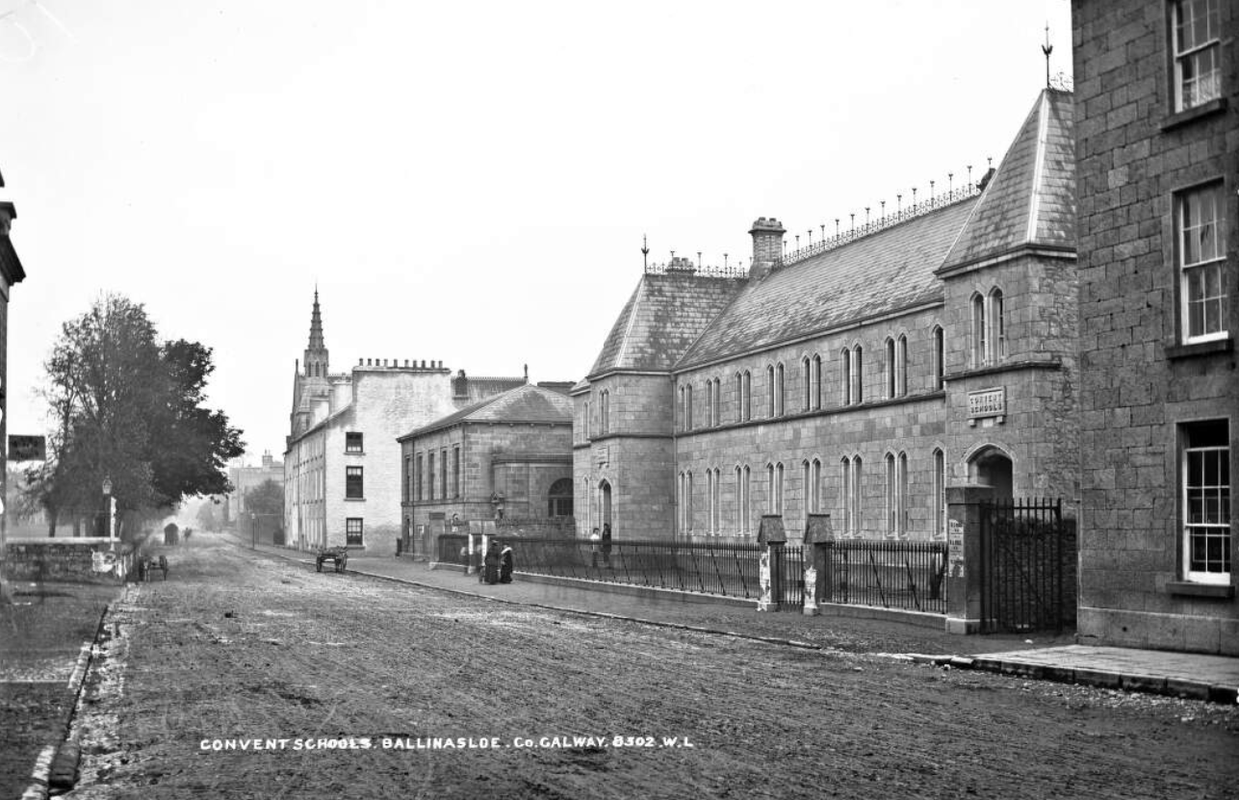
At Ballinasloe District Court on Saturday last, before Mr. J. H. Gallagher, D. J., was charged in custody with the alleged larceny of a purse containing 17s. 2d., and a pair of woolen gloves, the property of Miss Julia Burke, a teacher at the Convent of Mercy schools, Ballinasloe … Some time ago there was a gentlemen living in the house where accused was a servant, and he missed £75 … Miss Julia Burke’s deposition was to the effect that she was a teacher at the convent schools, and was in the classroom on November 14. Accused came there accompanied by a little girl. She said she had come for an overcoat belonging to a little girl of Mrs. Hills, Society St. She stated that the overcoat was left there by the child. Accused went into the classroom to get it and afterwards when she (Miss Burke) went in she found her coat, which was hanging on the wall, disturbed; the pocket lining was hanging out, and the purse and gloves were missing … Mrs. Hill deposed that when her little son arrived from school he said he had left his coat behind, and she was about to send him back again when accused came into the shop and on hearing her sending the child back for his coat, she volunteered to go with him. ―Connacht Tribune 24 November 1923, Page 6, Column 3


Convent of Mercy Schools (Society Street, Ballinasloe)

Why did Joyce alter £75 to six pounds fifteen (£6 15/- = 135 shillings = 1620 pence)? The same amount recurs in the following chapter, disguised as six victolios fifteen (RFW 065.34). Numbers are usually important in Finnegans Wake―note the familiar 1132 in this paragraph―but if these particular figures hold any significance, I am not aware of it.

In revising this section, Joyce made the protagonist an Austrian journalist, with the result that the final version is heavy with German words and grammatical constructions. But why Austrian? Perhaps Joyce simply wanted an excuse to use the German word Betreffender (person concerned), from the verb betreffen, which means both to encounter and to concern. This word also connects HCE’s attacker with the mysterious fender that figured earlier in this chapter in another version of the assault on HCE, and identifies Herr Betreffender as both offender and defender. HCE is both the attacker and the attacked: he is his own worst enemy.

German Elements

The prominence of an Austrian salesman and journalist has resulted in lending this paragraph a distinctly German flavour:

  • Betreffender German: Betreffender, person concerned

    • German: betreffend, concerning, regarding : in question, relevant
    • German: herbetreffend, aforementioned
    • zimmer holedigs summer holidays.
    • German: Zimmer, room.
    • Heinrich Zimmer: 19th century Celticist, author of Keltische Beiträge, a summary of which Joyce read : also his son, Indologist and linguist, author of Maya: Der Indische Mythos, which he sent to Joyce in 1938 with a dedication, and from which Joyce took some notes.
    • hole, dig. Bill Cadbury discerned a nice entombment echo here.
    • hole: small dingy lodgings
    • digs: lodgings
  • Kommerzial German: Kommerzialrat, Councillor of Commerce―a title awarded on an honorary basis to members of the business community who have served the Republic of Austria in a professional capacity.

    • commercial: commercial traveller, travelling salesman : tramp, vagrant
  • Gorbotipacco Italian: Corpo di Bacco, By Jove! As FWEET notes, the confusion between voiced and unvoiced consonants is typical of German mispronunciation of Italian.

  • wreaking German: rauchen, to smoke

  • Zentral Oylrubber German: Zentraleuropa, Central Europe

  • Osterich German: Österreich, Austria. The name means Eastern Kingdom. John Gordon suggests that ostrich may be included, evoking Australia (Southern Land). In Finnegans Wake Australia is an infernal underworld associated with Shem.

  • mark German: Mark, mark, a unit of currency

    • German: Ostmark, Eastern March, the forerunner of Austria in the Middle Ages
  • Gosh these wholly romads This phrase possibly conceals a reference to the Goths and other German tribes, who roamed as nomads across eastern Europe and invaded the Roman Empire. The Holy Roman Empire of the Middle Ages is also meant.

  • Yuly German: Juli July : Jul, Yule, Christmastide

  • wheil German: weil, because

  • swishing German: zwischen, between

  • swopping Swiss German: Schwob, a German, a Swabian

  • myth German: mit, with

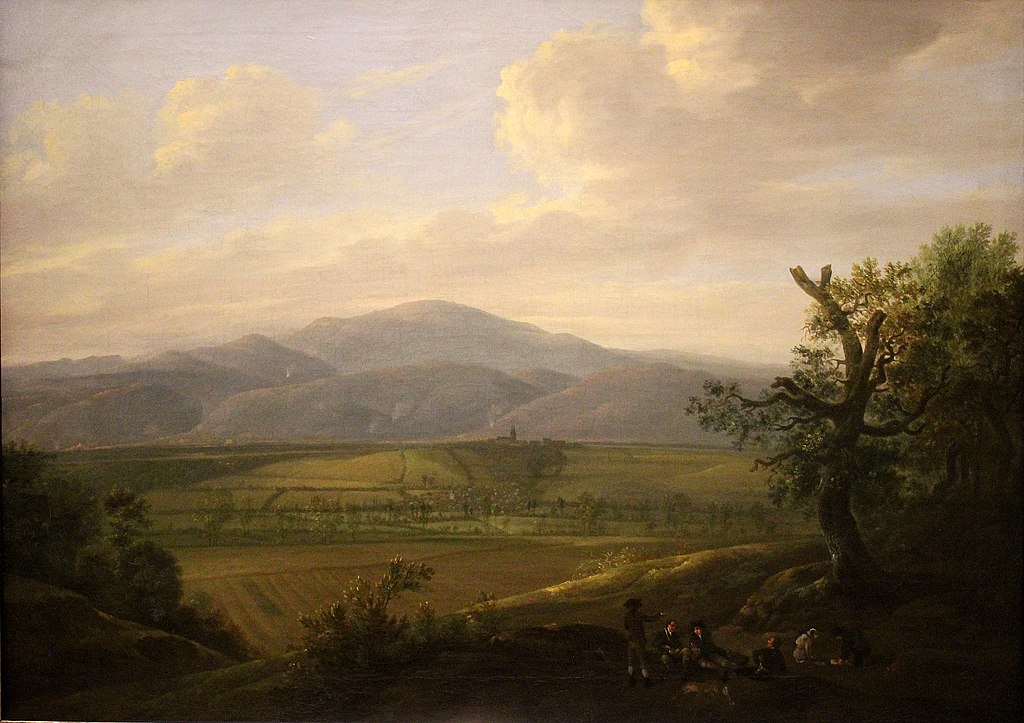
  • brockendootsch German: Der Brocken, The Brocken, the tallest peak in Germany’s Harz Mountains, and the scene of the Witches’ Sabbath (Walpurgisnacht) in Goethe’s Faust. It is also the site of the famous optical illusion known as the Brocken Spectre. The Scottish novelist James Hogg evokes the brocken spectre on Arthur’s Seat in Edinburgh in his novel The Private Memoirs and Confessions of a Justified Sinner, which is alluded to on a number of occasions in Finnegans Wake.

    • German: Brocken, morsel, crumb, fragment
    • Heinrich von Kleist, Der zerbrochene Krug (The Broken Jug), an allegorical play about the Fall of Adam
    • German: gebrochenes Deutsch, broken German


The Brocken

  • German: Der Fall Adams, The Case of Adam, The Adam Affair : The Fall of Adam

  • Frankofurto Siding German: Frankfurter Zeitung, Frankfurt Times, a German newspaper (see below)

  • Fastland German: Festland, Continent, Mainland (Europe). Fastland is the Danish form.

  • er German: er, he

  • constated German: konstatieren, to state : to establish, verify : to detect

  • that one had … disturbed In German the past participle in such grammatical constructions is placed at the end of the clause, as here.

  • lammswolle German: Lammwolle lamb’s wool

  • and wider German: und weiter, and, further, moreover

    • and wider … other German: entweder … oder, either … or
    • German: wieder, again
  • he might the same zurichschicken In German the infinitive in such constructions is placed at the end of the clause.

  • zurichschicken German: zurückschicken, to send back

    • Zurich, where Joyce lived for several years.


Universitätsstrasse 38, Zurich: Joyce’s Home in 1918

  • he would … become Another example of German grammar, in which the infinitive is thrown to the end of the clause.

  • tosend and obertosend German: tausend und abertausend, thousands and thousands

    • German: tosen, to roar, to rage
  • tonnowatters, German: Donnerwetter!, Gosh! : thunderstorm

  • monkey’s damages German: Affenschande, crying shame (literally: monkey-shame)

    • Artificial German: Affenschaden, monkey-damage
  • become German: bekommen, to get

  • and after this sort Literal translation of German: und nach dieser Art, and of this kind.

Michael Joyce

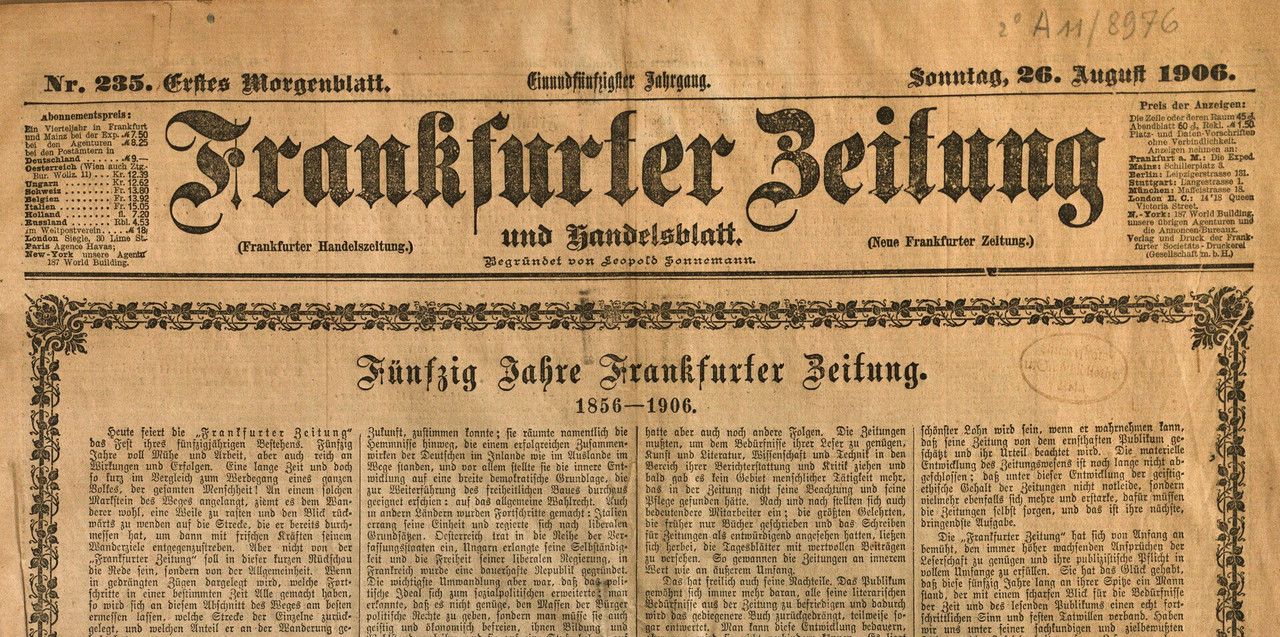
Was Herr Betreffender, contributor to the Frankfurter Zeitung, based on a real person? Adaline Glasheen believes that this is possibly the case:

*Betreffender, Herr (German “beforementioned”)―probably refers to Michael Joyce, English writer whose story Vielleicht ein Traum [Perchance a Dream] appeared in the Frankfurter Zeitung, 19 July 1931, and was attributed to James Joyce, who was pretty mad about it. See Letters, III, 224–32. ―Glasheen 30


Frankfurter Zeitung

In Letters III, we read Richard Ellmann’s footnote and translation of Joyce’s first letter about this story. The latter was in French and addressed to the poet Yvan Goll, whom Joyce had first met in Zurich:

The Frankfurter Zeitung published on 19 July 1931 a translation by Irene Kafka of a story, ‛Perchance a Dream,’ by Michael Joyce, originally published in the London Mercury. The newspaper attributed it to James instead of Michael Joyce, and to James Joyce the ‛error’ appeared disingenuous …

‛Dear Mr Goll: We have kept the postal receipt for the disc sent by registered mail. It has probably been stopped by the censorship and it is useless to send another. Now in Frankfurt, too, the Frankfurter Zeitung of 19 July has published a whole page of text by J. J., author of Ulysses, translated from the English manuscript by Irene Kafka. Who can she be ? Where has she found this manuscript which the newspaper attributes to me? I know nothing of it. I do not know her at all. I never wrote that silly story which is called Vielleicht ein Traum. I have never communicated with the Frankfurter Zeitung. Perchance a Dream but definitely an outrage. > Cordially yours James Joyce’ ―Letters III 30 July 1931 (Ellmann III:224)

Although Joyce had already made HCE’s attacker an Austrian commercial by June 1927, when a version of this chapter appeared in transition, the name Herr Betreffender and the references to the Frankfurter Zeitung date from the early 1930s, so Glasheen is probably correct in her analysis (JJDA).


David Spurr

I will conclude by quoting a lengthy paragraph from an article on this affair by David Spurr, Professor Emeritus of Modern English Literature at the University of Geneva:

An example of the latter tendency [to querulous paranoia] in Joyce’s life as a writer emerges from his response to the publication in 1931 of a short story entitled “Vielleicht ein Traum” under the name of James Joyce in the prestigious Frankfurter Zeitung. In a curious coincidence of names, the publication was in fact the translation by one Irene Kafka “from the English manuscript” of a story entitled “Perchance to Dream” by a writer named Michael Joyce. From what can be gathered of the facts of this affair, it appears that Kafka, subject to her own lapse, mistakenly wrote “James” for “Michael” and the editors of the Frankfurter Zeitung thought they were publishing the translation of a minor work by the famous Irish writer. In any case, alerted to this publication by his German publisher, Joyce’s reaction was nothing less than hysterical. He embarked on a campaign to identify Irene Kafka and Michael Joyce, to denounce the Frankfurter Zeitung and to seek (unsuccessfully) damages of $5,000 (equivalent to the purchasing power of at least $70,400 in 2010 …). With the help of Sylvia Beach, Joyce’s Paris publisher, this essentially banal affair took on the proportions of an international literary scandal―this despite apologies from the newspaper, the author of the original story and the translator. Ursula Zeller has shown a list of letters written during the three-month period from July to September 1931, in which more than 20 figures in the literary world took an active role. These include such names as T.S. Eliot, Sean O’Casey, Harold Nicolson, Harriet Shaw Weaver, Adrienne Monnier, Philippe Soupault, Padraic Colum and Ernst Robert Curtius. During this period, Joyce was entirely distracted from his work on the manuscript of Work in Progress (later Finnegans Wake). The Frankfurter Zeitung affair nonetheless made its way into the Wake, with a reference to the “Francofurto Siding” (70.04) a play on the Italian franco furto, meaning “outright theft.” What we can make of this bizarre coincidence of another Joyce with another Kafka is that James Joyce exhibits a kind of paranoia of the signature―a fear of the other’s appropriation of his proper name―that far surpasses any material or moral harm that could have come to him had he let the matter drop in the beginning. He was indeed compelled to do so in the end, but only after drawing the attention of most of the European literary world to the imagined damage to his reputation, and to the existence of an otherwise totally obscure writer named Joyce. To paraphrase what Stephen says of Shakespeare ([Ulysses] 9.999), the notes of persecution, banishment and betrayal sound continually in the language of Joyce. Similarly, the idea of the artist as assigned to the sewer of an otherwise clean-smelling world of letters ranges throughout Joyce’s work, from the early satirical verses all the way through Finnegans Wake, where, for example, Shem the Penman, a Joycean alter ego on trial for indecent exposure, is addressed in court as “you and your gift of your gaft of your garbage” (93.19–20). In a later episode Shem’s house is described in indignant tones as the house of O’Shame, “known as the haunted inkbottle” (182.30–31), a dwelling that exceeds everything “even in our western playboyish world for pure mousefarm filth” (183.04) ―Spurr 182–183


Leixlip (1910)

Leixlip

Although Finnegans Wake is unambiguously set in the Mullingar House in Chapelizod, Joyce often conflates this village with two nearby villages further upstream: Lucan and Leixlip. I have elsewhere suggested that Lucan (on the right bank of the Liffey) and Chapelizod (on the left bank) might represent HCE’s rival sons Shaun & Shem, with Lucalizod representing the Oedipal Figure who embodies both brothers. But what about Leixlip? Does this village, which is higher upstream than the other two, represent HCE himself?

The name is of Old Norse origin, meaning salmon leap, which refers to a weir on the Liffey which salmon must leap over on their journey upstream to spawn. HCE’s daughter Issy was born on 29 February, making her the Wake’s leap-year girl. Does this draw her into the Leixlip mix?

HCE is often identified with the Salmon of Knowledge of Irish mythology, and with Finn MacCool, who tasted the salmon and received all its wisdom. Phonetic resemblances tie this Salmon to the Biblical wise man Solomon. These and other fishy connections were explored by Marion Cumpiano in an essay that appeared in the James Joyce Quarterly in 1977:

The New Bridge, which crosses the Liffey a few kilometres upstream from Leixlip, was mentioned earlier in this chapter (RFW 050.40). Originally comprising four arches, it was recently rebuilt with three to facilitate the development of the adjacent water reservoir and the Leixlip hydro-electric dam 2 km downstream, which was constructed in 1945. The development of the hydro-electric plant destroyed the historic salmon leap.


Newbridge, Leixlip

I like the idea that Leixlip, being closer to the source of the Liffey than either Lucan or Chapelizod, stands for HCE, the progenitor of Shaun & Shem.

Loose Ends

And finally, let’s wrap up some loose ends:

  • lets wee brag of praties The Wee Bag of Praties, an Irish folk tune in Charles Stanford’s Complete Collection of Irish Music as Noted by George Petrie. The title means small bag of potatoes.

  • northroomer Presumably this simply means that Herr Betreffender occupied a room on the north side of HCE’s hotel. North-facing rooms in the Mullingar House overlook the Phoenix Park, where HCE encountered the Cad. John Gordon comments:

69.32-6: “northrooomer … 32 … Kommerzial:” Shem-type and Shaun-type, as usual accompanied by numbers 3 and 2. (Will be followed by an 11 at 70.1.) ―John Gordon

  • the Sockeye Sammon were stopping at the time Irish salmon (grilse) return to Irish rivers to spawn throughout the summer, and spawn from autumn through spring. The sockeye salmon, however, is found in the North Pacific Ocean. The Atlantic salmon (Salmo salar) is native to Ireland. O, by the by, there was a James Sammon, family grocer and wine merchant of 167 King Street, Dublin (Glasheen 254).

  • orange fasting ? Smoked salmon is orange, but cooked salmon is pink. Are the Sockeye Sammons eating nothing but oranges? In the late 18th and early 19th centuries Leixlip was the site of a popular health spa. Or are they Orangemen (Ulster Protestants)? Note the reference below to Holy Romans (Catholics).


Remains of the Leixlip Spa

  • to make a heart of glass to take heart to grass, a 17th-century corruption of to take heart of grace, meaning to take courage, to be courageous, to recover one’s courage, to take heart. Note the L/R Interchange, which is reversed below when laugh becomes raugh.

  • the game of gaze and bandstand butchery was merely a Patsy O’Strap Gazebos often double as public bandstands. There is one such structure in the Phoenix Park, and another in St Stephen’s Green. The Butchers’ March and Paddy O’Snap are two more tunes in Stanford’s Complete Collection of Irish Music. Butcher’s Wood in the Phoenix Park was the scene of the attack on Doctor Sturk in Sheridan Le Fanu’s novel The House by the Churchyard, a key text for Finnegans Wake. It was also the scene of the encounter between Joyce’s father and a tramp―the original seed from which HCE’s Encounter in the Park grew.

  • roebucks raugh at pinnacle’s peak The deer in the Phoenix Park are fallow deer, not roe deer. Joyce chooses Roebuck because there is a townland in Dublin of that name, and the word echoes Rubek, the hero of Henrik Ibsen’s last play, When We Dead Awaken, who dies on a mountain. In the next chapter, the attack on HCE will be rehearsed once more, but this time on a mountain. Of course, Lots of fun at Finnegan’s Wake is also in there.


Fallow Deer in the Phoenix Park

Joycean Errata

Most of the 9000-odd emendations made to the text of Finnegans Wake by the editors of The Restored Finnegans Wake, are relatively minor. The majority consist of changes in orthography and punctuation which many readers would not even notice. But here and there Danis Rose & John O’Hanlon have corrected more significant mistakes that crept into the text over the course of the sixteen or seventeen it took Joyce to write the novel. The most egregious of these involve the omission of complete lines―usually due to eyeskip by a typesetter when the book was being prepared for final printing.

One such errant line has been restored to the present paragraph:

a Kommerzial (Gorbotipacco, he was wreaking like Zentral Oylrubber) from Osterich, the U.S.E., paying (Gaul save the mark!) 11/- in the week (Gosh, these wholly romads!) and he missed a soft felt and, take this in, six quid fifteen of conscience money in the first deal of Yuly …

When this passage was first published in transition in 1927, it read:

a Kommerzial (Gorbotipacco, he was wreaking like Zentral Oylrubber) from Osterich, the U.S.E., paying (Gaul save the mark!) 11/- in the week (Gosh, these wholly romads!) of conscience money in the first deal of Yuly …

The line and he missed a soft felt and, take this in, six quid fifteen was overlooked by one of the typesetters for transition. Apparently, the line disappeared at draft Level 6, the first set of galleys for transition, in 1927:

At FW 70.02, the first transition galley proof, Level 6, lacks a full typed line from the typescript which was its model, Level 5, “and he missed a soft felt and, take this in, six quid fifteen”, and the loss is never repaired. Because it is such a common type of error, to skip from the end of one line to the beginning of the next line but one, I believe this is a transmissional departure rather than intentional change at what there is much evidence to believe was a now missing Level 5+* which was the typesetter’s actual model. ―Cadbury, Lost and Found

Rose & O’Hanlon have also restored the paragraph break after and after this sort. In the published version this paragraph ran on continuously all the way to Adyoe! (RFW 059.39).

And that’s as good a place as any to beach the bark of our tale.


References

  • Bill Cadbury et al, Genetic Joyce Studies, Centre for Manuscript Genetics, University of Antwerp, Antwerp (1999 ff)
  • Joseph Campbell, Henry Morton Robinson, A Skeleton Key to Finnegans Wake, Harcourt, Brace and Company, New York (1944)
  • Marion W Cumpiano, The Salmon and Its Leaps in “Finnegans Wake”, James Joyce Quarterly, Volume 14, Number 3, Pages 255–273, University of Tulsa, Tulsa, Oklahoma (1977)
  • Adaline Glasheen, Third Census of Finnegans Wake, University of California Press, Berkeley, California (1977)
  • David Hayman, A First-Draft Version of Finnegans Wake, University of Texas Press, Austin, Texas (1963)
  • James Hogg, The Private Memoirs and Confessions of a Justified Sinner, Longman, Hurst, Rees, Orme, Brown and Green, London (1824)
  • Eugene Jolas & Elliot Paul (editors), transition, Number 3, Shakespeare & Co, Paris (1927)
  • James Joyce, Finnegans Wake, The Viking Press, New York (1958, 1966)
  • James Joyce, James Joyce: The Complete Works, Pynch (editor), Online (2013)
  • Danis Rose, John O’Hanlon, The Restored Finnegans Wake, Penguin Classics, London (2012)
  • David Spurr, Paranoid Modernism in Joyce and Kafka, Journal of Modern Literature, Volume 34, Number 2, Pages 178–191, Indian Universiny Press, Bloomington, Indiana (2011)
  • Charles Stanford, Complete Collection of Irish Music as Noted by George Petrie, Parts I,–III, Irish Literary Society of London, Boosey & Co, London (1902–1905)

Image Credits

Useful Resources

01 March 2024

Now, By Memory Inspired


Now, By Memory Inspired (RFW 055.19–055.40)

The last ten pages of Chapter 3 of James Joyce’s Finnegans Wake comprise an episode known as The Battery at the Gate. This paragraph concludes Camelback Excesses (RFW 054.16–055.40), the second of the three subsections into which the Battery can be divided. An embattled HCE is placed under house arrest.

First-Draft Version

This paragraph, which takes up half a page in The Restored Finnegans Wake, began life as a single sentence, describing the incarceration of HCE for his own safety―an idea that will be elaborated in the following chapter:

First, there was a gateway for the suroptimist had bought and enlarged that shack to grow old & happy in and when everything was got up for the purpose he put a gate on the place and the gate was locked to keep HCE in, in case he felt like tempting providence. ―Hayman 74

In subsequent drafts the shack is identified―I think―with the outhouse behind HCE’s tavern:

  • in loo thereof In Ireland loo is still a common name for a lavatory or WC.

  • if he strikes a lousaforitch It is commonly believed that lighting a match in the WC can mask the smell of faeces. A lucifer is a self-igniting match.

  • the iron gape … was triplepatlockt on him Remember how we had to apply to the janitrix, the Mistress Kathe for her passkey to the locked Museyroom. As John Gordon notes, the outhouse in Finnegans Wake is often locked. See, for example, RFW 404.04–31, which has many points in common with the present paragraph. triplepatlockt alludes to the trio of HCE’s enemies: Shem, Shaun & the Oedipal Figure. There is clearly an allusion here to The Tripartite Life of St Patrick. There may also be an allusion to the Norse trickster god Loki―Valhalla, Odin and the Eddas are mentioned a few lines above.

  • the jags In Dublin, jacks is the common form of jakes, English slang for toilet or WC.

The Soroptimist International is a women’s volunteer service founded in 1921. Why HCE is described as a suroptimist I cannot say. The prefix sur means super, so perhaps HCE is being unrealistically optimistic in thinking that he will be allowed to grow old and happy in his shack without being further troubled by the local populace.


Violet Richardson Ward, Founding President of the Soroptimist International

The first draft was written in November 1923. By June 1927, when a later draft of this chapter appeared in Eugene Jolas & Elliot Paul’s literary journal transition, Joyce had expanded it to nineteen lines. Note that there is still no paragraph break before the following section, which begins with O, by the by …:

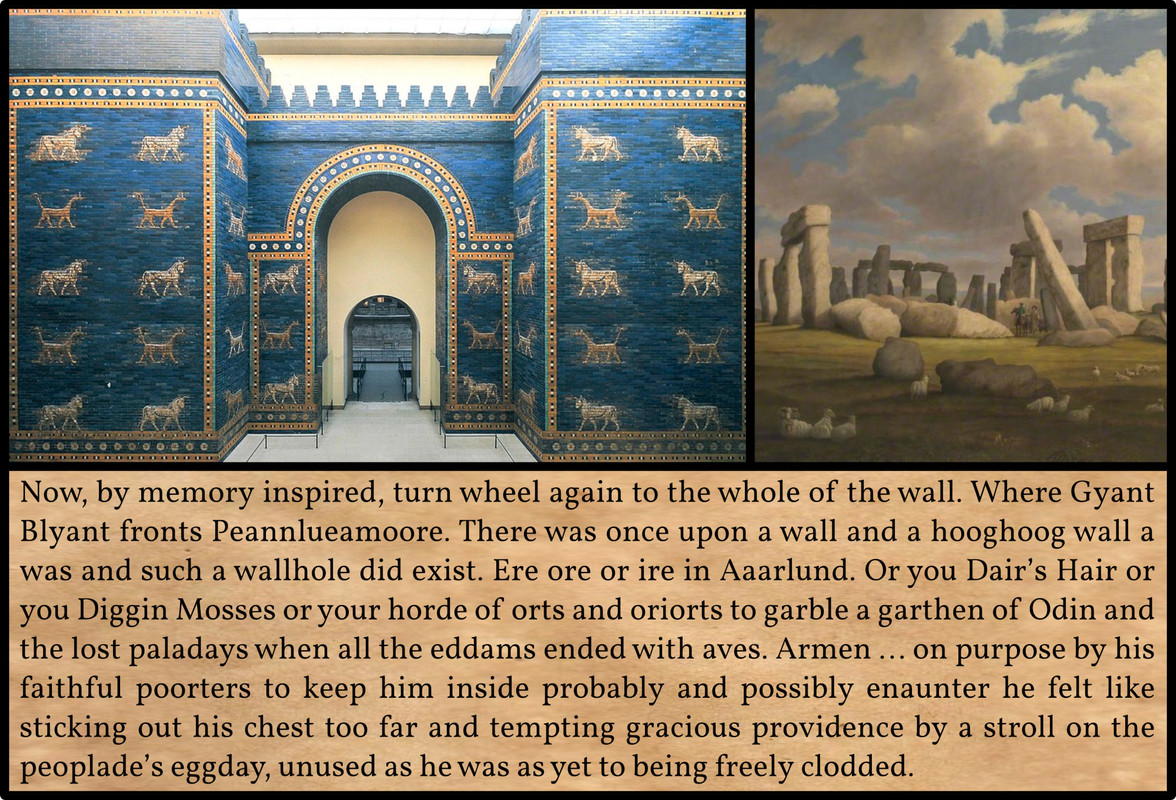
Now turn wheel again to the whole of the wall. There was once upon a wall and a hooghoog wall a was and such o wallhole did exist. A stonehinged gate then was for another thing while the suroptimist had bought and enlarged that shack under fair rental of one yearlyng sheep, (prime) value of sixpence, and one small yearlyng goat (cadet) value of eightpence, to grow old and happy (hogg it and kidd him) for the reminants of his years; and when everything was got up for the purpose he put a gate on the place by no means as some pretext a bedstead in loo thereof to keep out donkeys (the pigdirt hanging from the jags to this hour makes that clear) and just thenabouts the iron gape, by old custom left open to prevent the cats from getting at the gout, was triplepatlockt on him on purpose by his faithful poorters to keep him inside probably and possibly in case he felt like sticking out his chest too far and tempting gracious providence by a stroll on the nation’s eggday, unused as he was yet to being freely clodded. ―Jolas & Paul 46–47

When Joyce later revised this section he slightly elaborated what he had written and inserted half a dozen lines of new material before the mention of the stonehinged gate. As we shall see, this new material draws parallels between HCE’s current predicament and both his Oedipal Encounter with the Cad and his domestic relationship with his daughter, Issy.


The Wellington Monument

Back to the Phoenix Park

The opening lines of this paragraph hark back to HCE’s encounter in the Phoenix Park with the Cad with a Pipe.

  • by memory inspired HCE’s current situation recalls his earlier one. One could say that the whole of Finnegans Wake is by memory inspired. This phrase is the title of an anonymous Irish ballad celebrating the heroes of several Irish rebellions and political movements. It was included in Padraic Colum’s Anthology of Irish Verse, which was published in 1922.

  • turn wheel again to the whole of the wall The Hole in the Wall was a nickname for the Black Horse Tavern, Nancy Hand’s pub on Blackhorse Avenue, Dublin. This public house was located next to a pedestrian turnstile in the outer wall of the Phoenix Park. The turning of the wheel has obvious Viconian connotations. The Battery at the Gate is another case of history repeating itself.


The Hole in the Wall

  • Gyant Blyant fronts Peannlueamoore In the Phoenix Park Encounter HCE was described as the flaxen Gygas when he was pointing at the Wellington Monument.

    • Greek: gigas, giant.

    • In Thomas Malory’s Le Morte d’Arthur Lancelot, having gone insane, is held captive for his own safety by Sir Blyaunte.

    • During the Cad Encounter the Wellington Monument was referred to as his duc de Fer’s overgrown milestone, but later, when this episode was being recounted to a namecousin of the late archdeacon F. X. Preserved Coppinger, it was called that overgrown leadpencil.

    • Irish: peann luaidhe mór, big lead pencil. I don’t understand the apparent allusion to Thomas Moore. The ballad By Memory Inspired is not one of his. Perhaps the writer George Moore is meant. Louis Mór is an Irish translation of the French: Louis le Grand, Louis XIV, but I don’t see the relevance.

    • Danish: blyant, pencil.

  • a garthen of Odin and the lost paladays when all the eddams ended with aves It need hardly be remarked that the Phoenix Park does duty as the Garden of Eden. HCE’s Crime in the Park is Finnegans Wake’s Original Sin. Note the allusions to John Milton’s Paradise Lost and to Adam and Eve. Odin and the Eddas add a Scandinavian dimension―always appropriate, considering that Dublin was originally a Norse settlement. John Gordon suggests an allusion also to the Paladins, the Twelve Peers of Charlemagne, who die heroically at the Pass of Roncevaux in the Chanson de Roland. Unlikely, but paladin does occur before the end of this chapter (RFW 059.11).

  • if he strikes a lousaforitch The Cad with a Pipe was called the luciferant, which not only identifies him with the Devil―the serpent in the Garden of Eden―but also refers to his striking a match to light his pipe.


Four-Poster Bed with Robert Adam Fireplace

The Fireplace

It is surely significant that both the Cad with a Pipe and HCE’s daughter Issy are associated with fire. When HCE was a younger man, Issy slept in the room above the Mullingar House’s master bedroom. Whenever she talked in her sleep, her voice was transmitted down the chimney flue to invade the night thoughts of HCE―avoice from afire. As John Gordon notes, the first line of this paragraph alludes to the fireplace as the whole of the wall:

The ‛whole of the wall’ to which HCE now ‛turn[s]’ has a triple meaning at least: he is a dying man turning his face to the wall, the enamoured father/lover turning his attention to the fireplace hole in the wall from which Issy’s voice comes, and that fellow who some time ago roused himself to see to the hole punched in his wall by hail, tree, and wind, anthropomorphised as rock-throwing balladeers. ―Gordon 135

  • ore Danish: øre, ear.

  • Aaarlund Dutch: aar, ear (of corn, grain, etc).

The ear is the organ through which Issy poisons HCE’s mind. In Shakespeare’s Hamlet, Claudius assassinated Hamlet’s father by pouring poison into his ear as he slept.

  • Isther Estarr play Yesther Asterr Jonathan Swift’s close friends Esther Johnson (Stella) and Esther Vanhomrigh (Vanessa) represent Issy in Finnegans Wake. In the present context, in which a gate is constructed and locked to keep HCE in and his enemies out, there may be an allusion to Babylon’s famous Ishtar Gate (see Finnegans, Wake!).


The Murder of Hamlet’s Father

Armenia

This paragraph includes a foliation of Armenian terms. They are all to be found in half-a-dozen lines that Joyce added in 1938, about one year before the finished novel was published―Galleys 2nd set, May 1938, I.3 draft level 10, JJDA. Like all the other Armenian clusters in Finnegans Wake, Joyce flags this one by including a distortion of the word Armenian (here as Armen, which is also German for the poor):

Ere ore or ire in Aaarlund. Or you Dair’s Hair or you Diggin Mosses or your horde of orts and oriorts to garble a garthen of Odin and the lost paladays when all the eddams ended with aves. Armen. The doun is theirs and still to see for menags if he strikes a lousaforitch and we’ll come to those baregazed shoeshines if you just shoodov a second. And let oggs be good old goggles and Isther Estarr play Yesther Asterr. In the drema of Sorestost Areas, Diseased. ―RFW 055.21–28

  • ôre ôr, day by day

  • der, Mr, sir (form of address to secular clergy)

  • hayr, Father (form of address to regular clergy)

  • digin, Mrs

  • orti, son : young man

  • ôriort, young woman

  • doun, house

  • menag, solitary, alone

  • Lousavorich, Illuminator (title given to Saint Gregory, first patriarch of Armenia)

  • barekeadz, living a good life

  • shoushan, lily : Lily, Susan (girl’s name)

  • shoudov, hastily, quickly

  • ogi, spirit


A Map of the Terrestrial Paradise

The Garden of Eden is traditionally located in Armenia, near the sources of the Tigris and Euphrates Rivers. It is hardly a coincidence that this foliation of Armenian words occurs in a passage that mentions the garthen of Odin, lost paladays, and eddams & aves. Most of the Armenian terms in Finnegans Wake are associated with the Garden of Eden (Halper 19–24).

Joyce’s spelling of these words in the Finnegans Wake notebooks appears to be phonetic, which suggests that his source was someone who spoke Armenian rather than a dictionary or other written text.

Some Loose Ends

And finally, let us tie up some loose ends.

  • There was once upon a wall and a hooghoog wall a was This clause echoes the opening line of Joyce’s A Portrait of the Artist as a Young Man: Once upon a time and a very good time it was …

    • Dutch: hoog, high
  • There was once upon a wall … and let oggs be good old gaggles … Estarr … on the peoplade’s eggday The People’s Eggday is Easter Sunday, the Day of the Resurrection―with all its Viconian connotations―but the principle eggy allusion here is surely to Humpty Dumpty on his wall.

    • Old Irish: og, egg

    • French: peuplade, tribe, people


Humpty Dumpty

  • Sorestost Areas, Diseased Irish: Saorstát Éireann, Irish Free State. This was the official name of the 26-county state between 1922 and 1937, when Joyce was writing Finnegans Wake. Diseased possibly alludes to Hamlet’s There is something rotten in the state of Denmark.

  • he put an applegate on the place by no means as some pretend a bedstead The detail of the use of a bedstead―the framework that supports a bed―as a gate was taken from All on the Irish Shore: Irish Sketches by Somerville & Ross. This particular sketch, A Grand Filly, describes a foxhunt:

It was pretty to see the yellow horse jump. Nothing came amiss to him, and he didn’t seem able to make a mistake. There was a stone stile out of a bohireen that stopped every one, and he changed feet on the flag on top and went down by the steps on the other side. No one need believe this unless they like, but I saw him do it. The country boys were most exhilarating. How they got there I don’t know, but they seemed to spring up before us wherever we went. They cheered every jump, they pulled away the astounding obstacles that served as gates (such as the end of an iron bedstead, a broken harrow, or a couple of cartwheels), and their power of seeing the fox through a stone wall or a hill could only be equalled by the Röntgen rays. We fought our way through the oak wood, and out over a boggy bounds ditch into open country at last. ―Somerville & Ross 121

  • applegate The Forbidden Fruit in the Garden of Eden is traditionally identified as an apple.

  • the iron gape, by old custom left open to prevent the cat from getting at the gout Another borrowing from one of Joyce’s favourite newspapers, the Connacht Tribune:

House Burning … Dead Goat Precautions. At Galway Quarter Sessions on Tuesday, before the Recorder, Judge Doyle, K.C., Mrs. H. Connelly, Moycullen, sought compensation for the destruction of a dwellinghouse and its contents … The door of witness’s sister’s house had been hasped. ―“Why was it?” inquired the Recorder. ―Witness: We had killed a goat, and the door was hasped in order to prevent the cat getting at the goat (laughter). ―Connacht Tribune 16 February 1924 5/3

Rose & O’Hanlon believe that Joyce made the note door hasped to prevent the cat getting at goat (VI.B.1:1p), but when he later came to use this note he misread it as door open to prevent the cat getting at goat (JJDA). gape conveys the notions of both a barrier (gate) and a gaping hole.

  • by old custom left open A callback to the Prankquean Episode, which was based on an incident in the life of Grace O’Malley, the Pirate Queen. As a result of an altercation between her and the Earl of Howth, the doors of Howth Castle were by custom always left open at dinner time and an extra place was set at table (Gordon 69.24).

  • his faithful poorters The Four Old Men are also the four posts which support HCE’s four-poster bed and resemble the bars of a cage. In the opening chapter of the book they advise Tim Finnegan not to rise during his wake (RFW 019.24 ff). Later, they physically restrain him (Hold him there, Ezekiel Irons … ―RFW 022.03), which may be echoed in iron gape. The Latin: porta, gate, door, is also present. In the context of Stonehenge (stonehinged), there may also be an echo of portal dolmen, an ancient Celtic tomb that resembles a stone doorway (to the afterlife?). Joyce visited Stonehenge in August 1931, during a brief trip to Salisbury (Ellmann 639 : Norburn 150). Megalithic monuments were once believed to be the graves of giants.

Significantly, Joyce uses Dutch words here―in Dutch means in trouble. This phrase has even been traced to the Irish word duais (also duabhais and duadhas), meaning toil, trouble, difficulty, labour (Cassidy 138 : Dineen 373).

  • Dutch: poort, gate : poorters, citizens, burghers

And that’s as good a place as any to beach the bark of our tale.


References

  • Joseph Campbell, Henry Morton Robinson, A Skeleton Key to Finnegans Wake, Harcourt, Brace and Company, New York (1944)
  • Daniel Cassidy, How the Irish Invented Slang: The Secret Language of the Crossroads, CounterPunch, Petrolia, California (2007)
  • Padraic Colum, Anthology of Irish Verse, Boni and Liveright, New York (1922)
  • Patrick S Dinneen, An Irish-English Dictionary, New Edition, Revised and Greatly Enlarged, Irish Texts Society, Dublin (1927)
  • Richard Ellmann, James Joyce, New and Revised Edition, Oxford University Press, Oxford (1982)
  • John Gordon, Finnegans Wake: A Plot Summary, Syracuse University Press, Syracuse, New York (1986)
  • Nathan Halper, Armenian, A Wake Newslitter, New Series, Volume 16, Number 2, Pages 19–24, University of Essex, English Department, Colchester (1979)
  • David Hayman, A First-Draft Version of Finnegans Wake, University of Texas Press, Austin, Texas (1963)
  • Eugene Jolas & Elliot Paul (editors), transition, Number 3, Shakespeare & Co, Paris (1927)
  • James Joyce, A Portrait of the Artist as a Young Man, B W Huebsch, New York (1916)
  • James Joyce, Finnegans Wake, The Viking Press, New York (1958, 1966)
  • James Joyce, James Joyce: The Complete Works, Pynch (editor), Online (2013)
  • Roger Norburn, A James Joyce Chronology, Palgrave Macmillan, London (2004)
  • Danis Rose, John O’Hanlon, The Restored Finnegans Wake, Penguin Classics, London (2012)
  • Edith Œnone Somerville & Martin Ross, All on the Irish Shore: Irish Sketches, Longmans, Green, and Co, London (1903)

Image Credits

Useful Resources

19 January 2024

Now to the Obverse


Romulus and Remus (detail)

The last ten pages of Chapter 3 of James Joyce’s Finnegans Wake comprise an episode known as The Battery at the Gate. This paragraph commences the second of the three subsections into which the Battery may be divided: Camelback Excesses (RFW 054.16–055.40). In the published book this section is less than two pages long and comprises a pair of paragraphs.

First-Draft Version

The earliest draft of the first of these paragraphs comprised only a handful of lines, recounting the fates of the two victims―ie Issy―of HCE’s Crime in the Park. Joyce originally planned to place this section immediately after the Plebiscite and Street Interview (RFW 047.13–049.29), which concluded with an episode involving two girls, Questa and Puella and three drummers:

First these outrages were thought to have been instigated by either or both of the rushy hollow heroines but one drank carbolic and her sister in love, finding she stripped well, felt her hat too small for her. But a little thought will allow the facts to fall in and take up their due places. If violence to life, limb and goods has as often as not been the expression, direct or through male agents, of offended womanhood has not levy of blackmail from the earliest ages followed upon in worldlywise? ―Hayman 74

One of the girls commits suicide by drinking carbolic acid―a not uncommon way of committing suicide in the 1920s―while the other gets a swelled head and blackmails HCE. Both details―the drinking of carbolic acid and the swelling of the head―were lifted by Joyce from stories in the 27 January 1923 issue of the Evening Standard.

By the time Joyce had finished revising this paragraph it had grown to more than a page in length and had become much more obscure. The sentence in the middle of the first draft―But a little thought … due places―was dropped and replaced by twenty-eight lines of brand new material, drawn from the usual bewildering variety of sources. These revisionist additions recast the two girls as instigators of the attack on HCE rather than the victims of his crimes.

[](https://i.postimg.cc/Qt4XPHTK/Battery-At-The-Gate-Subsections.png

The first ten or eleven lines do little more than elaborate the opening sentence of the first draft.

  • velveteens gamekeepers, from the fact that they traditionally wore velveteen―a kind of cotton―trousers. I presume this alludes to the three soldiers―Shem, Shaun & the Oedipal Figure―who spy on HCE in the Park. The Plebiscite and Street Interview mentioned two velvetthighs and concluded with a reference to their three drummers.

  • dimities Dimity comes from the Ancient Greek: δίμιτος [dímitos], of double thread, so dimities may refer to the two Issys, or to the twins Shem & Shaun.

  • a fivefinger span a handsbreadth. FWEET defines a five-finger span as a cluster of keys on the piano, but I don’t see how this is relevant.

  • hence these camelback excesses HCE. This attack on HCE’s reputation is like the straw that broke the camel’s back.

  • Oh! Oh! In Germany 00 (Null-Null) is sometimes used to indicate a WC or public toilet. HCE’s Crime in the Park often involves him peeping at two young girls as they urinate amongst the foliage. Hence the references to the two girls as intoxicating liquors―margarita and posca―and to HCE as binocular man.


Null-Null

Dramatis Personae

Most of the additions to this paragraph were in place when a version of this chapter was published in Eugene Jolas & Elliot Paul’s literary journal transition in June 1927. Several characters from legend, history and literature were given rôles to play in the expanded drama:

  • dilalah Delilah, the woman who loved and then betrayed Samson. By replacing de- with di- Joyce underscores her two-faced nature. A note in one of his Finnegans Wake notebooks equates her with Brangäne, Isolde’s handmaid.

  • Lupita Lorette Spanish: Lupita, a diminutive of the female given name Guadalupe, which is derived from the toponym meaning Valley of the Wolf : the name, allegedly, of one of Saint Patrick’s sisters. French: lorette, prostitute, after the Parisian church of Notre-Dame-de-Lorette. Latin: lupa, she-wolf : prostitute. According to legend, Lupita proved her chastity by carrying hot coals without getting burned, which may be alluded to in the mention of soft coal below―though it is her sister Luperca who is being spoken of there.

  • Luperca Latouche Latin: Luperca, the she-wolf that suckled Romulus and Remus, the legendary founders of Rome : the wife or a priestess of Lupercus, the Roman equivalent of Pan. Rose La Touche was the pupil, cherished student and muse on whom the English art historian John Ruskin based his tract on education and culture Sesame and Lilies (1865). She was ten years old when she first met the 39-year-old Ruskin, and probably in her teens when he began a romantic relationship with her. She twice turned down his proposal of marriage, and died in Dublin in 1875 at the age of just 27. Ruskin’s intermittent insanity, which began to afflict him in 1877, has been attributed to his grief over her death.


Rose La Touche & John Ruskin

  • her jambs were jimpjoyed to see each other French: jambes, legs. As her legs were always spread, they rarely saw each other. It is surprising to find so direct an allusion to James Joyce in the text of Finnegans Wake. He haunts every page of the book but is rarely named so explicitly. In the transition draft Joyce wrote: her galbs were glad to see each other. French: galbe, curve, outline, silhouette, especially the curvaceous outline of a fine figure.

  • Graunya … the greatsire of Oscar, that son of a Coole Gráinne was the heroine of the Irish tale of The Pursuit of Diarmuid and Gráinne, which tells essentially the same story as Richard Wagner’s opera Tristan und Isolde. She was betrothed to the much older Finn MacCool but at the wedding feast she served Finn and his guests a sleeping potion and eloped with one of Finn’s younger henchmen Diarmuid. Finn was the grandfather of Oscar and the son of Cumhail (Cool). Gráinne was also the Irish name of Grace O’Malley, the 16th-century Irish pirate queen, and the inspiration for Joyce’s Prankquean. The concurrence of Oscar and Coole also brings Oscar Wilde into the mix. The Wild Swans at Coole was the name of two collections of poetry by William Butler Yeats, published in 1917 an 1919. Coole Park, near Gort in County Galway, was the home of Lady Gregory. As we learned in an earlier article, Oscar was not the only member of the Wilde family to be mired in sexual controversy. His father William Wilde was found guilty of sexually assaulting a young woman Mary Travers.

  • arrah of the lacessive poghue ALP and Arrah-na-Pogue, the eponymous heroine of Dion Boucicault’s melodrama about love and loyalty, which is set against the backdrop of the United Irishmen’s Rebellion of 1798. Arrah-na-Pogue is a key text for Finnegans Wake.


The Marriage of Strongbow and Aoife

  • she, come leinster’s even, true dotter of a dearmud Aoife (Eve), the daughter of Diarmait Mac Murchada (Dermot MacMurrough), King of Leinster. She married the Anglo-Norman warlord Strongbow (Richard de Clare, 2nd Earl of Pembroke) in 1170.

  • her pitch was Forty Steps and his perch old Cromwell’s Quarters Cromwell’s Quarters is a short stepped lane in Kilmainham, Dublin. It was popularly known as The Forty Steps. It was formerly known as Murdering Lane or Cutthroat Lane. The modern name was adopted in 1892 and refers not to Oliver but to his fourth son Henry Cromwell, who was Lord Deputy of Ireland (1657–58) and Lord Lieutenant of Ireland (1658–59).


Cromwell’s Quarters (1935)

  • valkirry Valkyries: in Norse mythology and Wagnerian opera, female attendants who choose fallen heroes from the battlefield and lead them to Valhalla. Possibly evoked by the allusion to Yeats’s Wild Swans:

These heavenly maidens were not first imagined by himself [Muhammad]. They are noticed in the Persian hymns, much earlier, as meeting the pious: they are the Apsaras (or “watermovers”) of the great Indian epic, who wed heroes in heaven; the Valkyries (“hero-choosers”), and swan maidens, of the Norse, which were the white clouds. ―Conder 239–240

  • Arcoforty Italian: arco forte, strongbow. Noah’s Ark and the forty days and forty nights are also relevant, as is his rainbow: Italian: arcobaleno, rainbow. The colours of the rainbow (iridescent huecry) are encoded in the following sol-fa musical notes: down right mean false sop lap sick dope (do re mi fa so la ti do).

  • Tawfulsdreck German: Teufelsdreck, Devil’s shit. Teufelsdreck was the name Thomas Carlyle originally bestowed on the subject of his satirical novel Sartor Resartus. Under pressure from his publisher, he disguised this as the less objectionable Teufelsdröckh. This novel is another key work for Finnegans Wake.


Thomas Carlyle & Sartor Resartus

  • A reine of the shee, a shebeen quean, a queen of pranks The Queen of Sheba, and the Prankquean. French: reine, queen. Rain figures prominently in both Noah’s story and that of the Prankquean. Anglo-Irish: shee_, fairy. Anglo-Irish: shebeen, an illicit tavern. Hebrew: שֶׁבַע‎ (shebha), seven. Archaic: quean, prostitute. In Shakespeare Titania was the Queen of the Fairies, but as there is no Oberon or Bottom, she may not be relevant here―unless Oberon is the kingly man.

  • by the beer of his profit by the beard of the Prophet!, an oath popularly supposed to be used by Muslims. The Prophet Muhammad features prominently in Finnegans Wake (see below for further discussion).

  • wilde erthe blothoms followed an impressive private reputation for whispered sins? Oscar Wilde, again:

Willie Wilde [Oscar’s elder brother] came over to London and got employment as a journalist and was soon given almost a free hand by the editor of the society paper The World. With rare unselfishness, or, if you will, with Celtic clannishness, he did a good deal to make Oscar’s name known. Every clever thing that Oscar said or that could be attributed to him, Willie reported in The World. This puffing and Oscar’s own uncommon power as a talker; but chiefly perhaps a whispered reputation for strange sins, had thus early begun to form a sort of myth around him. He was already on the way to becoming a personage; there was a certain curiosity about him, a flutter of interest in whatever he did. ―Harris 1:53–54


Padraic Colum

Wild Earth is the name of a short collection of poems by Padraic Colum, his first book of poetry (1907). The title is borrowed from the concluding line of one of the poems, which is quoted in the Scylla and Charybdis episode of Ulysses :

As in wild earth a Grecian vase. ―Colum 14

Young Colum and Starkey. George Roberts is doing the commercial part. Longworth will give it a good puff in the Express. O, will he? I liked Colum’s Drover. Yes, I think he has that queer thing, genius . Do you think he has genius really? Yeats admired his line : As in wild earth a Grecian vase. Did he? ―Ulysses 184

Colum may be referenced by the phrase a column of lumps, though this is also another borrowing from Walter Hubert Downing’s Digger Dialects, meaning In disorderly military formation (Downing 17). Colum’s name―he was born Patrick Columb―comes from the Latin: columba, dove, which pairs Issy’s raven (ravenous).

Padraic Colum was born a few weeks before Joyce but outlived him by more than thirty years. He and Joyce first met in 1901 or early 1902 at one of Lady Gregory’s at homes (Mary & Padraic Colum 10). They later struck up an acquaintance in the National Gallery and remained close friends ever after (Mary & Padraic Colum 18–19).


Luperca: The Capitoline She-Wolf

Dogs

In Finnegans Wake Issy’s two dominant personalities are usually depicted as a dove and a raven, and both of these are present in this paragraph (soiled dove … eyes ravenous and possibly in the allusion to Padraic Colum). But here Issy and HCE are also portrayed as dogs:

  • Lupita Latin: lupa, she-wolf.

  • Luperca the she-wolf that suckled Romulus and Remus.

  • sfidare him, tease fido, eh tease fido, eh eh tease fido Fido is a common name for a dog. Italian: sfidare, to challenge : ti sfido, I challenge you : fido, I trust : faithful. Dogs are called Fido because they are faithful creatures, but these two bitches are anything but faithful.

  • dug of a dog of a dgiaour, ye! giaour is a Turkish term of reproach for non-Muslims, especially Christians.

John Gordon sums up this paragraph in the following words:

67.28–69.04 [the long paragraph we are now studying] re-evokes the mirror-girl Issy as femme fatale sending ‛many a poor pucker packing to perdition’, whispering provocative messages down to her defunct old victim―dog, king, ‛ravenous’ raven-eyed blind relic of a ‛dead era’. ―Gordon 135


Aslim Taslam

Islam

This passage is also replete with references to Islam, which I will leave you to uncover for yourself. Why Joyce decided to include these elements in this particular paragraph is a question I cannot answer. Perhaps the camel in the second line made Joyce think of Arabia. In The Books at the Wake James Atherton explains why Joyce drew so heavily upon the Koran when writing Finnegans Wake:

The Koran interested Joyce not only because it is one of the world’s major sacred books but also for a technical reason which made it useful for his purpose; it is not only sacred but also extremely difficult to interpret. Perhaps it has been the necessity of making a reputedly infallible book conform with all the changing needs of Islamic civilization in successive centuries that has led to the growth of the intricate science of Koranic exegesis, perhaps it is the intricacy of the Koran itself; but no book―not even the Bible―has been studied with such devoted subtlety.

Hughes’s Dictionary of Islam contains, in the article ‛Qur-ān’, a subsection purporting to give a brief outline of the ways in which the Koran has been explained. This summary, which Hughes declares to be exiguous and inadequate, contains well over a thousand words. But, since there is a possibility that Joyce read it and used it, I will give here an even more exiguous summary of Hughes’s ‛brief outline’, aiming at exemplifying the intricacy of the system rather than explaining its intricacies:

  1. The words are of four classes: special, hidden, ambiguous, and complex.

  2. Sentences are of two kinds: obvious and hidden.

  3. Obvious sentences may be clear, explained, technical, or incontrovertible.

  4. Hidden sentences may conceal a second meaning, may have two obvious but incompatible meanings, may display a whole variety of meanings, or may have no meaning that any human intelligence can grasp.

  5. There are four levels of meaning. They are literal, figurative, palpable, and metaphorical.

But this last point is subject, Hughes tells us, to debate; and he adds that some Islamic scholars maintain that there are more than four levels of meaning. The alternative usually put forward is seven, but other larger numbers have been suggested. This business of finding multiple meanings in a sacred book is an ancient and reputable occupation for scholars which must have been well known to Joyce. Several years have gone by since Professor Levin first suggested in his pioneer book, James Joyce, A Critical Introduction, that the four levels of meaning which Dante declared to be present in the Divine Comedy were present also in Finnegans Wake. It now seems certain that this is true; but with Joyce’s customary ‛toomuchness … fartoomanyness’ (122.36), it also seems certain that there are more than four levels, and that one of the purposes, and the results, of the slow process of accretion that produced the Wake was the addition of more and more levels to the literal foundation. ―Atherton 207–208


Quran 21:5

Surah_ 21, The Prophets―possibly alluded to in this paragraph (by the beer of his profit)―contains the following verse, which might just as easily be said of Finnegans Wake:

Yet they say, “This [Quran] is a set of confused dreams! No, he has fabricated it! No, he must be a poet! So let him bring us a [tangible] sign like those [prophets] sent before.” ―Mustafa Khattab, The Clear Quran 21:5

A Few Loose Ends

  • à la zingara in the manner of a Gypsy. This evokes a cluster of Romani terms towards the end of this paragraph, which Joyce took from George Borrow’s dictionary of the Romani language.

  • Tomar’s Wood The Norse name for a wood that once stood in the vicinity of the modern Phibsboro and Drumcondra. During the Battle of Clontarf Brian Ború’s forces were stationed here.

I’ll close with a quotation from Finnegans, Wake!, an online blog maintained by a group of enthusiasts from Austin, Texas, which is always worth a glance or two:

Nor needs none shaft ne stele from Phenicia or Little Asia to obelise on the spout, neither pobalclock neither folksstone, nor sunkenness in Tomar’s Wood to bewray how erpressgangs score off the rued.

It is a very dense and difficult sentence to unpack, but there are some good clues in there. That word stele refers to a type of ancient monument, a stone slab with inscriptions. You’ve got an obelisk, another monument, in there. The portmanteau word pobalclock combines two Irish words which basically translate to folk-stone and there is folksstone following right after pobalclock. FWEET mentioned that there is a stone pillar monument in the town of Folkestone in England marking the spot where Saxon invaders landed on the shores. You see where this is going? The sentence essentially says we don’t need monuments to mark where the invaders landed, we don’t need to recognize those erpressgangs―a word combining the German erpressen meaning to blackmail or extort and also press-gangs which were groups that kidnapped men and forced them to enlist in the military. ―_Finnegans, Wake!

And that’s as good a place as any to beach the bark of our tale.


References

  • James S Atherton, The Books at the Wake: A Study of the Literary Allusions in James Joyce’s Finnegans Wake, The Viking Press, New York (1960)
  • George Borrow, Romano Lavo-Lil: or English Gypsy Language, John Murray, London (1888)
  • Joseph Campbell, Henry Morton Robinson, A Skeleton Key to Finnegans Wake, Harcourt, Brace and Company, New York (1944)
  • Mary & Padraic Colum, Our Friend James Joyce, Doubleday & Company, Inc, Garden City, New York (1958)
  • Padraic Colum, Wild Earth: A Book of Verse, Maunsel & Co, Limited, Dublin (1907)
  • Claude Reignier Conder, The Rise of Man, John Murray, London (1908)
  • Walter Hubert Downing, Digger Dialects: A Collection of Slang Phrases Used by the Australian Soldiers on Active Service, Lothian Book Publishing Co, Melbourne and Sydney (1919)
  • John Gordon, Finnegans Wake: A Plot Summary, Syracuse University Press, Syracuse, New York (1986)
  • Frank Harris, Oscar Wilde: His Life and Confessions, Volume 1, Frank Harris, New York (1918)
  • David Hayman, A First-Draft Version of Finnegans Wake, University of Texas Press, Austin, Texas (1963)
  • Eugene Jolas & Elliot Paul (editors), transition, Number 3, Shakespeare & Co, Paris (1927)
  • James Joyce, Finnegans Wake, The Viking Press, New York (1958, 1966)
  • James Joyce, James Joyce: The Complete Works, Pynch (editor), Online (2013)
  • Danis Rose, John O’Hanlon, The Restored Finnegans Wake, Penguin Classics, London (2012)

Image Credits

Useful Resources


For in those deyes

  The Sacrifice of Isaac : The Green Woods of Truagh The last ten pages of Chapter 3 of James Joyce’s Finnegans Wake comprise an episode ...